
How to See the Milky Way's Core, From Anywhere on Earth
Author
Rishabh Nakra
Date Published
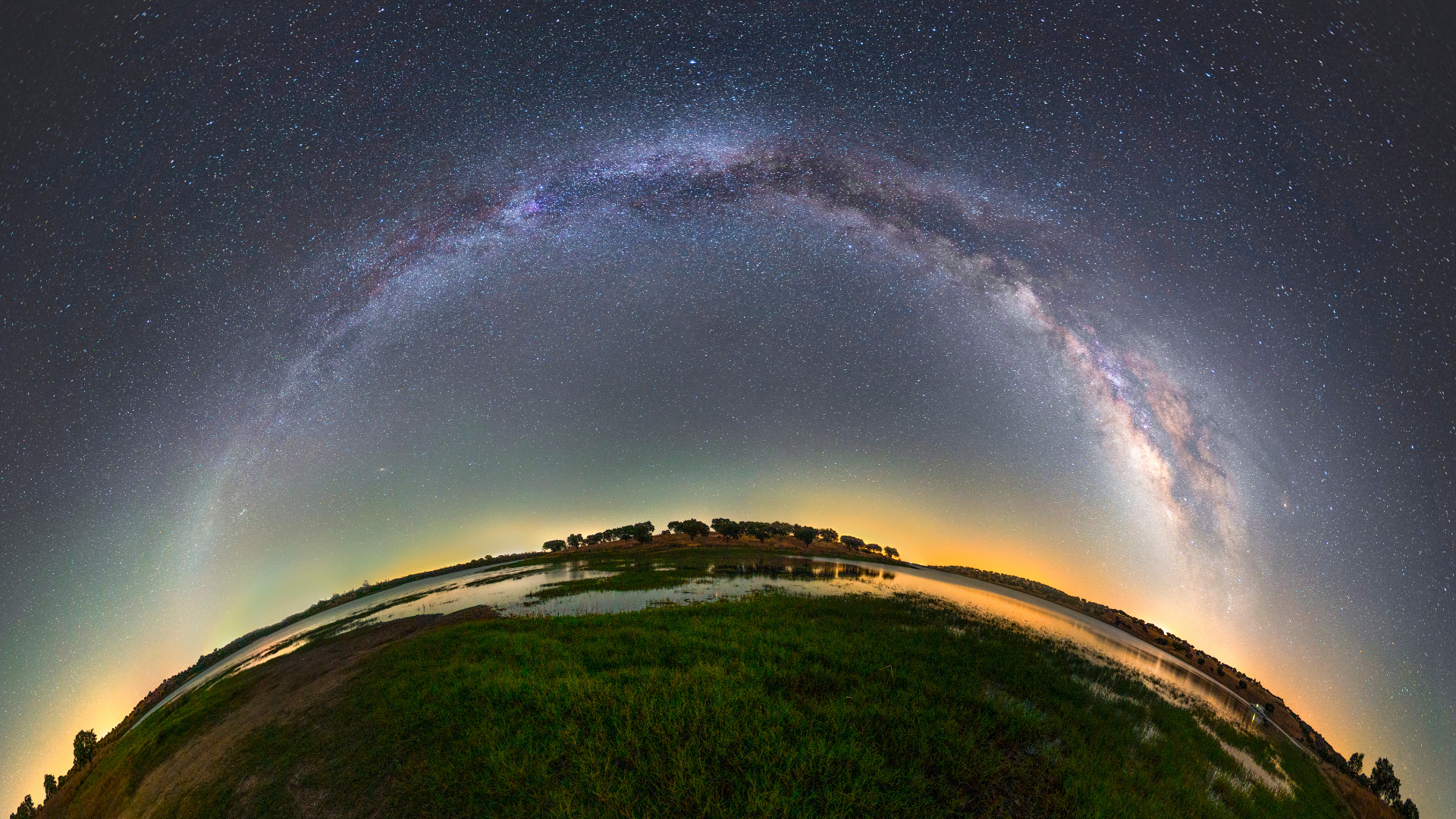
You cannot step outside our galaxy to admire it. You are stuck inside it, sitting in the flat disk of stars, which is why the Milky Way shows up not as a graceful spiral but as a pale band smeared across the night sky. The brightest, most detailed stretch of that band, the part in every photograph, is the galaxy's crowded core, roughly 26,000 light-years away in the direction of the constellation Sagittarius.
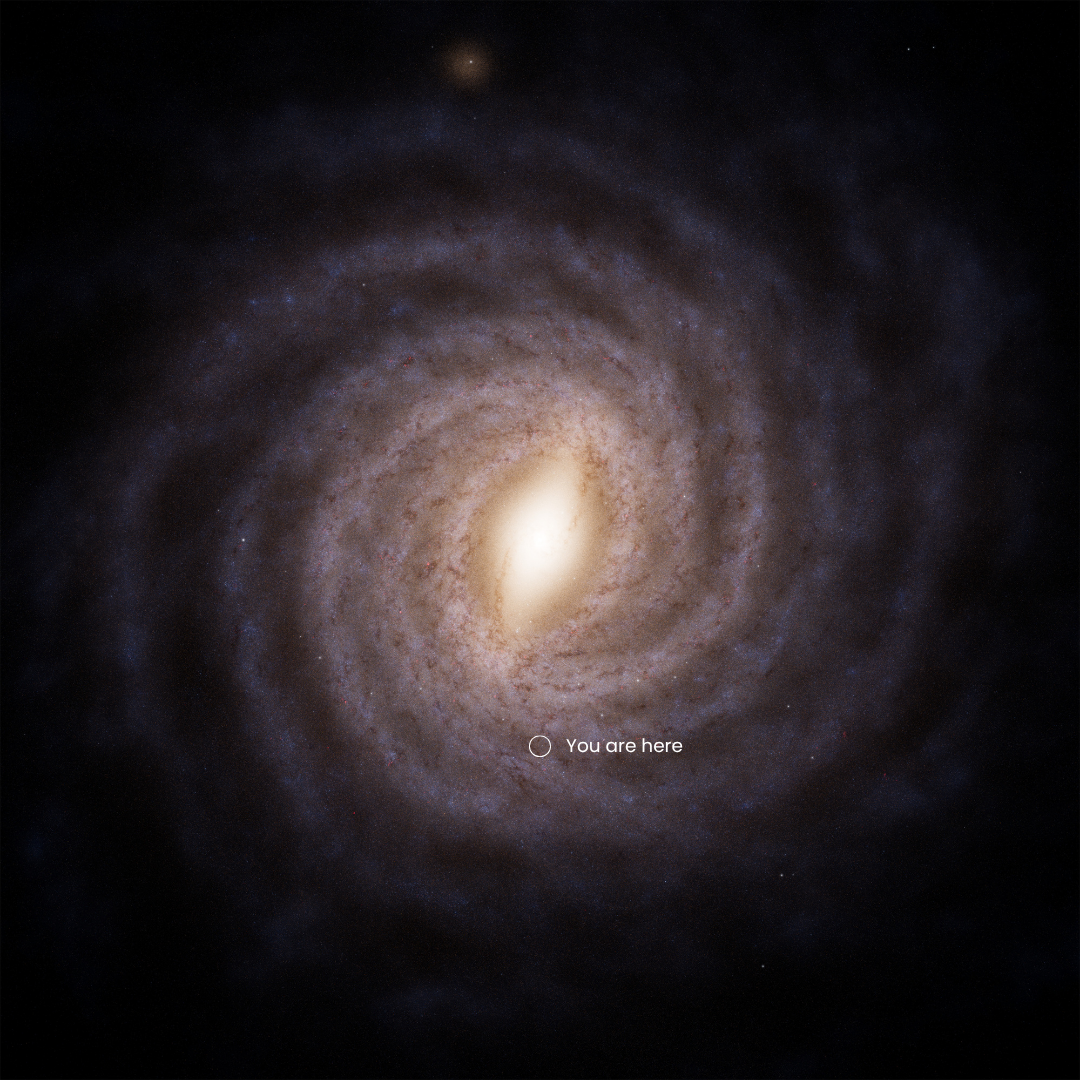
The best Milky Way map, by Gaia
Here is the strange part. That glowing core is not on offer every night of the year. It has a season. For a few months, the entire planet gets its best view of the very same thing at very nearly the same time, and the reason has almost nothing to do with which hemisphere you happen to stand in.
The View From Inside The Disk
The Milky Way is a flat spiral, and the Sun sits about two-thirds of the way out from the middle, tucked into one of its arms. When you look along the plane of that disk, your line of sight runs through countless distant stars packed edge to edge, and they blur together into a milky glow. Look away from the plane, into the emptier space above or below it, and the stars thin out fast.
The richest part of the band lies toward the center of the galaxy, in and around Sagittarius and neighboring Scorpius. This is what people mean when they say they have finally seen the Milky Way: dense clouds of stars, dark ribbons of dust cutting across them, and a brightness the outer galaxy never comes close to matching. The light reaching your eye from that core left it around 26,000 years ago.
That same patch of sky is the most crowded hunting ground in the amateur's catalogue. Sagittarius alone holds more entries from Charles Messier's famous list of fuzzy objects than almost any other constellation, among them the glowing Lagoon Nebula and the tight ball of ancient stars known as M22. On a dark night the brightest of them show up to the naked eye as soft knots along the band.
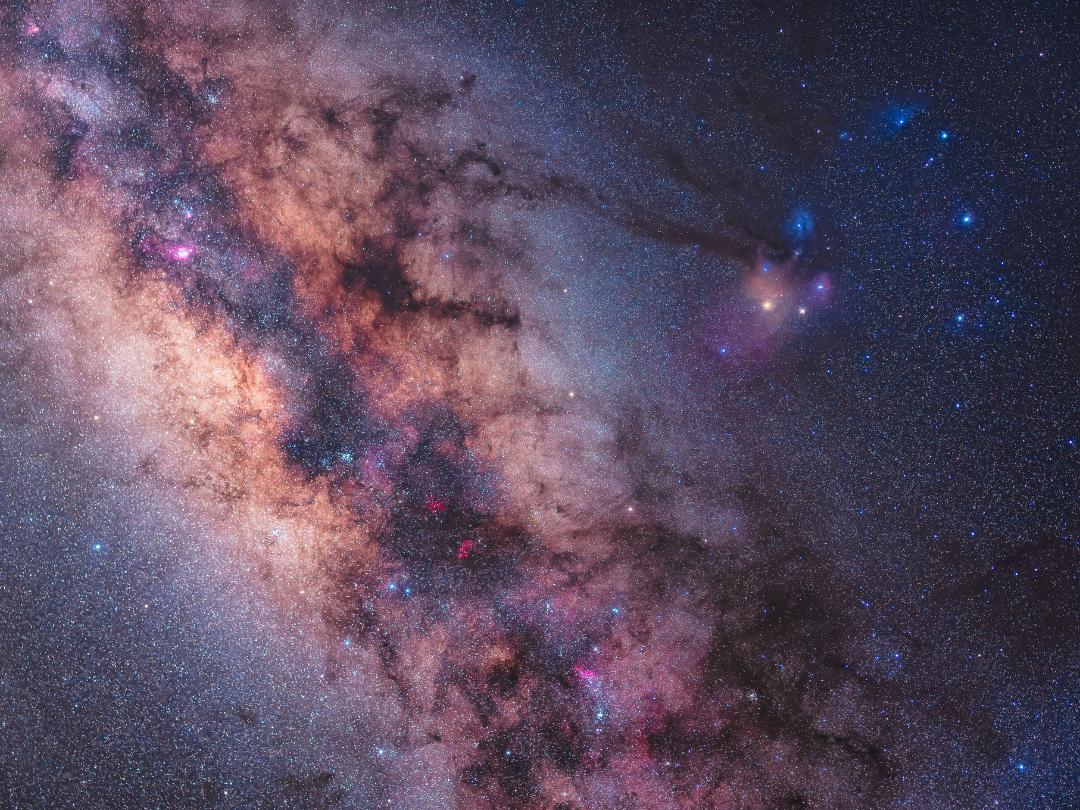
The Galactic Center in Sagittarius at left and the constellation of Scorpius seen in full here at centre and at right. The Dark Horse prances at top with dark tendrils of dust reaching down to yellow Antares and the colourful emission and reflection nebulas of the Rho Ophiuchi area.
Hidden behind all that dust is the anchor of the whole structure. Sagittarius A*, a black hole of about 4.3 million times the Sun's mass, marks the galaxy's gravitational center. No eye or backyard telescope will ever pick it out. Reinhard Genzel and Andrea Ghez shared the 2020 Nobel Prize in Physics for tracking stars whipping around that invisible mass and proving what it had to be.
You can face that direction on any clear night. Whether the core is above your horizon after dark is a separate question entirely.
Why June To August Belong To Everyone
Earth's night side, the half of the planet turned away from the Sun, points in a different direction as Earth travels around its orbit. From roughly June through August, that night side faces toward the heart of the galaxy in Sagittarius. The core then rises as darkness falls and climbs to its highest point around the middle of the night.
Follow the months backward and the timing shifts. Early in spring the core clears the horizon only just before dawn, giving a brief window in the small hours. By late spring it is up by midnight; by June it is visible for most of the night; by late summer it already stands high as the sky darkens and sets before morning.
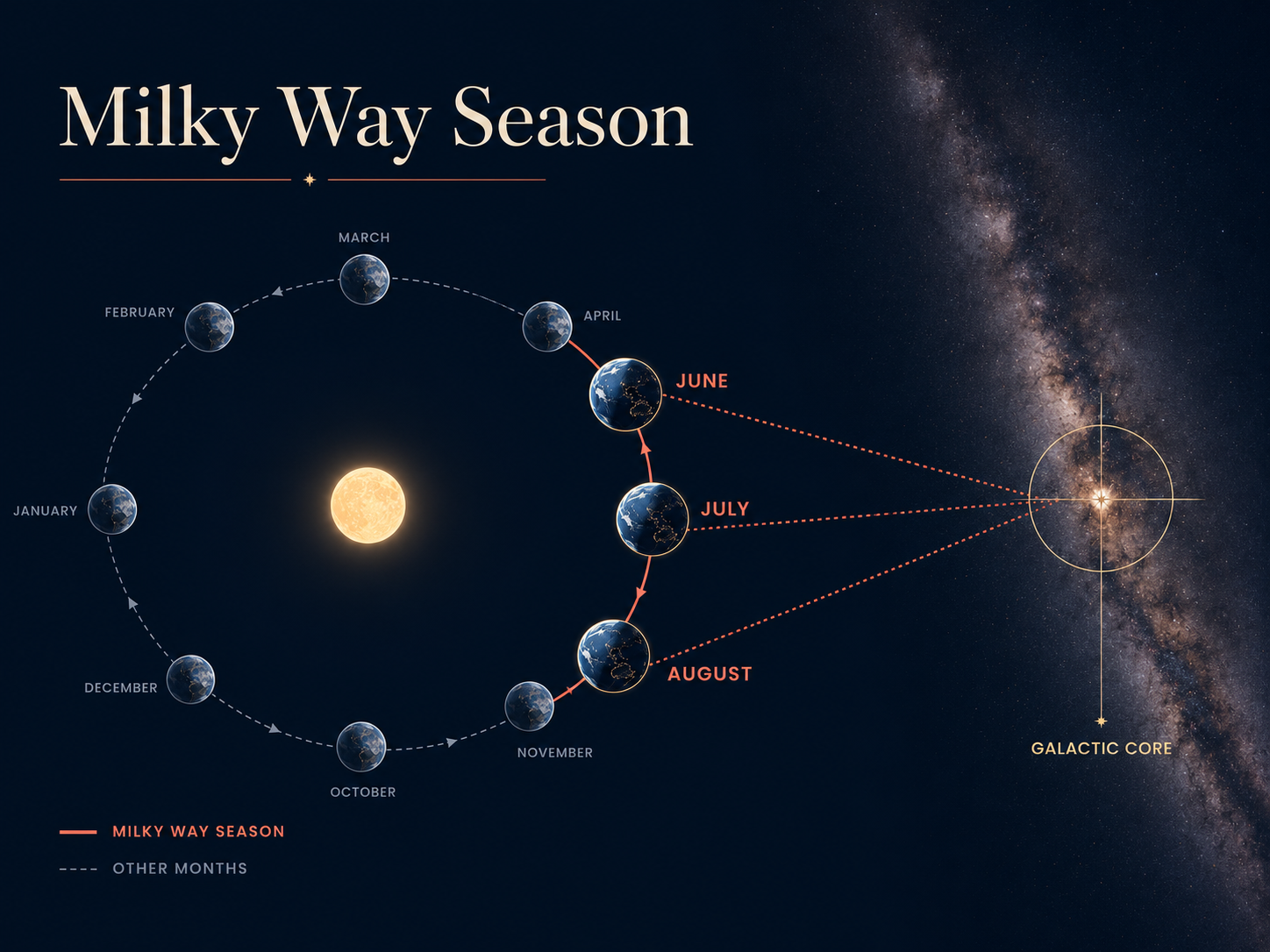
The Milky Way Season
Six months from the peak, the geometry flips completely. Through November, December, and January the galactic center sits on the daytime side of Earth, drowned in the Sun's glare. At night we face outward instead, toward the sparse rim of the disk, and the bright core is simply absent from the sky.
That schedule is fixed by where Earth is in its orbit, not by where you are standing on it. The same face of the planet swings toward Sagittarius in June whichever hemisphere you call home. This is why the peak season belongs to the entire world at once, from Chile to Canada, rather than to one half of it.
What changes from place to place is not the calendar. It is the angle.
The Same Sky At Different Heights
From the middle latitudes of the north, think southern Europe, the United States, or central Asia, the core never climbs high. It hangs low over the southern horizon, reaching perhaps 30 to 45 degrees up around midnight before sliding back down. You look south to find it.
Move toward the equator and it rides higher. From the southern hemisphere the contrast is dramatic: the core passes nearly overhead, the band arcs from one horizon to the other, and because June through August is winter there, the nights are long and the dark runs deep. Australia, Chile, and southern Africa arguably deliver the finest naked-eye view of the galaxy anywhere on Earth.
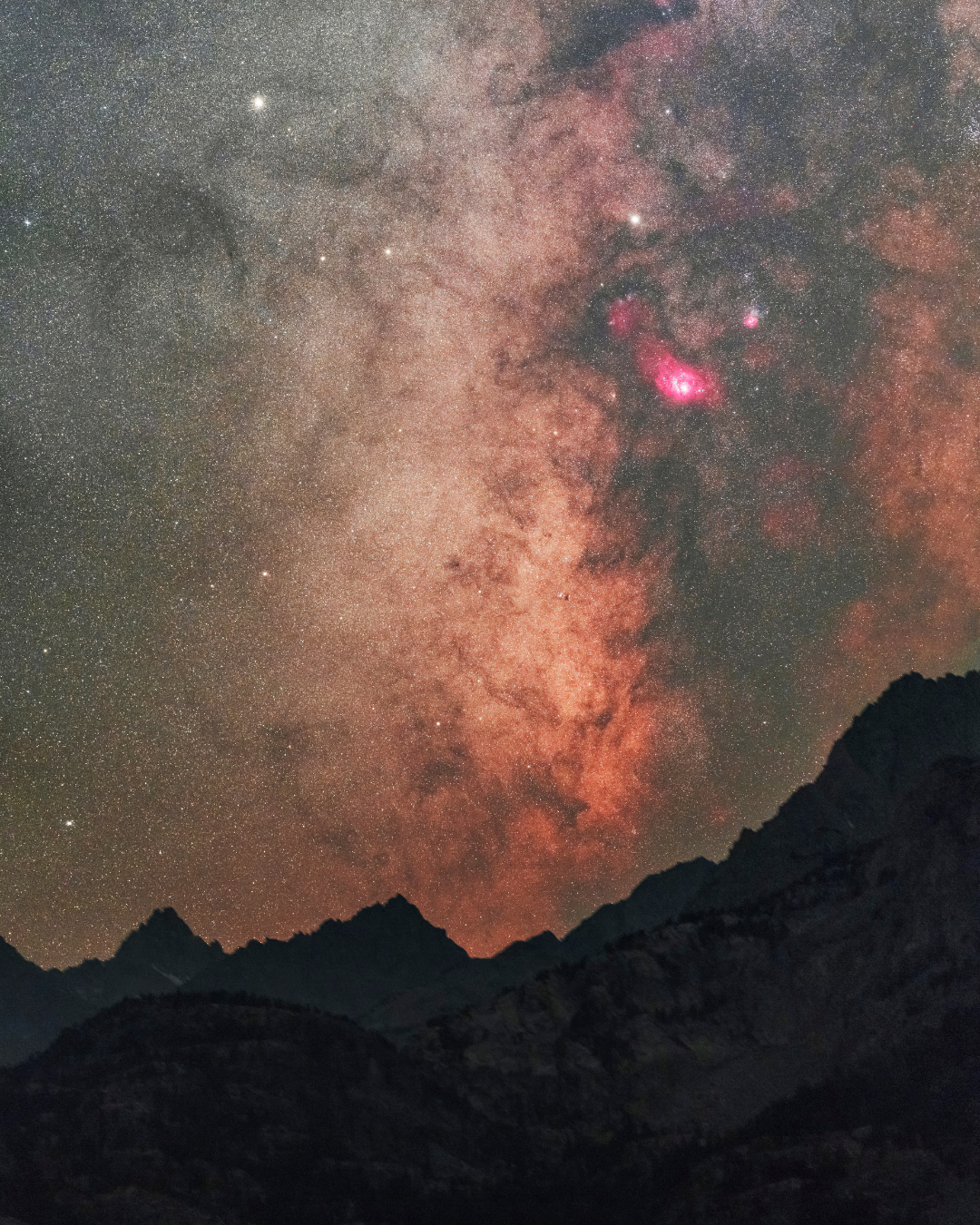
Central core of the Milky Way. The Lagoon nebula (red) is at right. The Milky Way is our galaxy seen from the inside.
There is one catch, and it lands on the far north. Above about 49 degrees of latitude, near the June solstice the Sun never sinks far enough below the horizon for genuine night. Much of Britain, Scandinavia, and Canada trades its darkness for weeks of lingering twilight, so the core stays washed out even while it is technically in season.
Closer to the equator, nobody has that problem. The core climbs high and the sky goes fully black. Wherever you are, the move is the same: face the brightest part of the band, find the group of stars in Sagittarius shaped like a teapot, and watch for the pale "steam" rising from its spout. That steam is the core.
Darkness Is The Whole Game
Knowing when and where to look counts for nothing under a bright sky, and most of humanity now lives beneath one. A global survey of light pollution published in 2016 by Fabio Falchi and colleagues found that artificial skyglow hides the Milky Way from more than a third of all people, including roughly 80 percent of North Americans and 60 percent of Europeans. More than 80 percent of the world lives under light-polluted skies.
From a city, the core is invisible, full stop. The usual yardstick is the Bortle scale, which rates sky darkness from 1 for untouched wilderness to 9 for a glaring city center. To see the core properly you want Bortle 4 or darker, which almost always means driving well away from town. A light-pollution map makes finding such a spot straightforward.
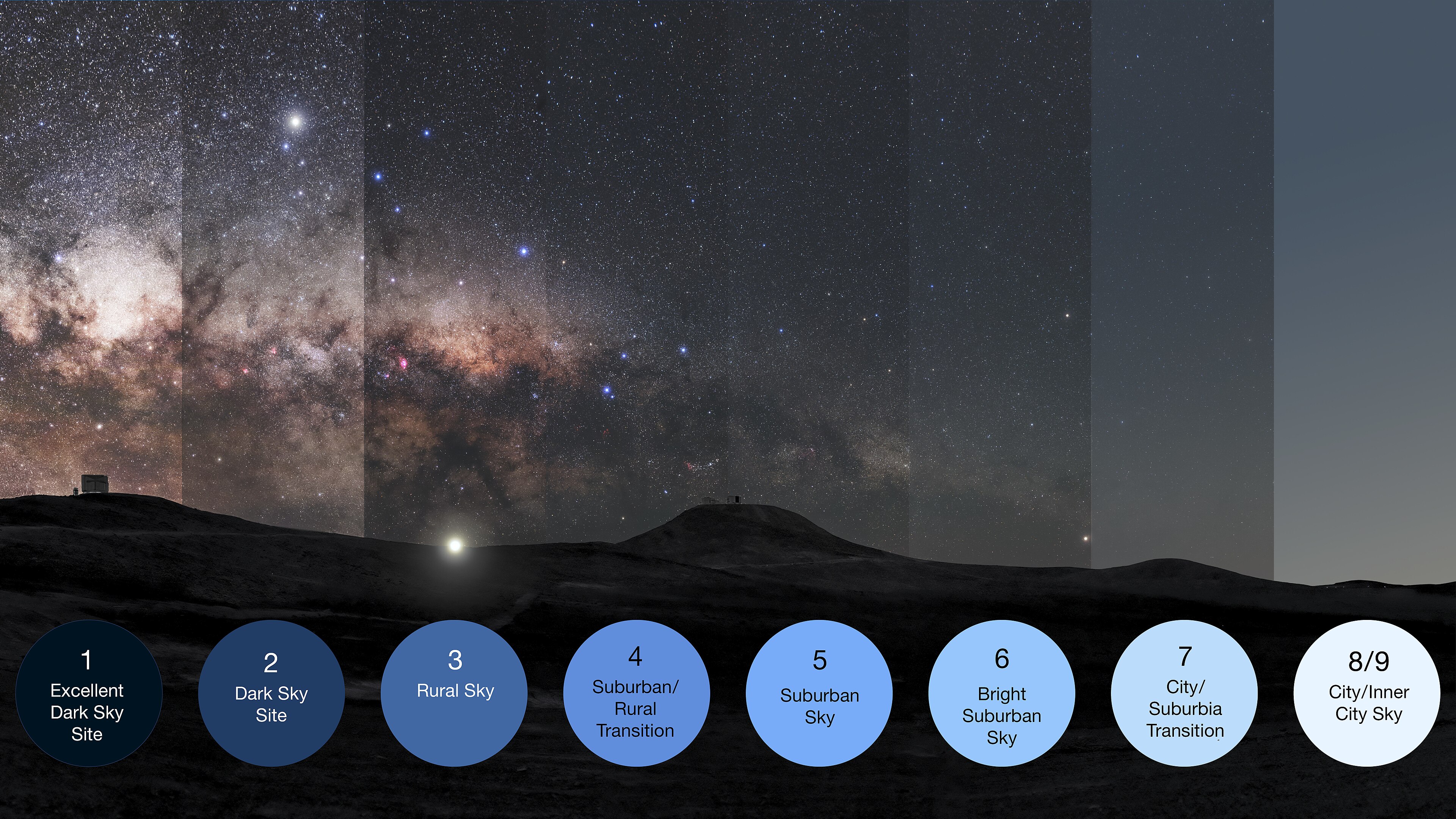
The Bortle Scale
The Moon is the other spoiler, and a fiercer one than any city. Around the full Moon its glow floods the sky and erases the faint band outright. Careful observers plan their outings within a few days of the new Moon, when the sky reaches its darkest and the core stands out most.
Get every one of those factors right, and only one thing still stands between you and the galaxy. Your own eyes.
Letting Your Eyes Catch Up
Human eyes need time to unlock their low-light sensitivity. The rod cells in your retina take 20 to 30 minutes in darkness to reach full strength, lifting your sensitivity by something like ten thousand times. A single glance at a phone screen resets the entire process in an instant, which is why astronomers work by dim red light rather than white.
There is a trick worth learning as well. The rods that gather faint light sit off to the sides of your retina, not dead center, so aiming your gaze slightly to one side of the band often makes it jump into view. Astronomers call this averted vision.
Timing counts down to the hour, too. True darkness arrives only once the Sun drops 18 degrees below the horizon, the point astronomers call the end of astronomical twilight, usually 90 to 120 minutes after sunset. Wait for it.
A cheap pair of binoculars changes the experience again. Sweep them slowly along the core and the smooth glow breaks apart into layered fields of individual stars, and the brighter deep-sky objects resolve into real shapes: the Lagoon Nebula as a patch of pale mist, M22 as a grainy sphere of light. Nothing else in the sky rewards a modest instrument so generously.
Do all of this on a clear, moonless July night from a genuinely dark site, and the core rises as a textured river of light, split down its length by a dark lane of dust called the Great Rift. By October it sinks lower each evening, and by the northern winter it slides behind the Sun altogether. The window shuts for months. Then Earth swings back toward Sagittarius, and the whole planet gets its turn again.
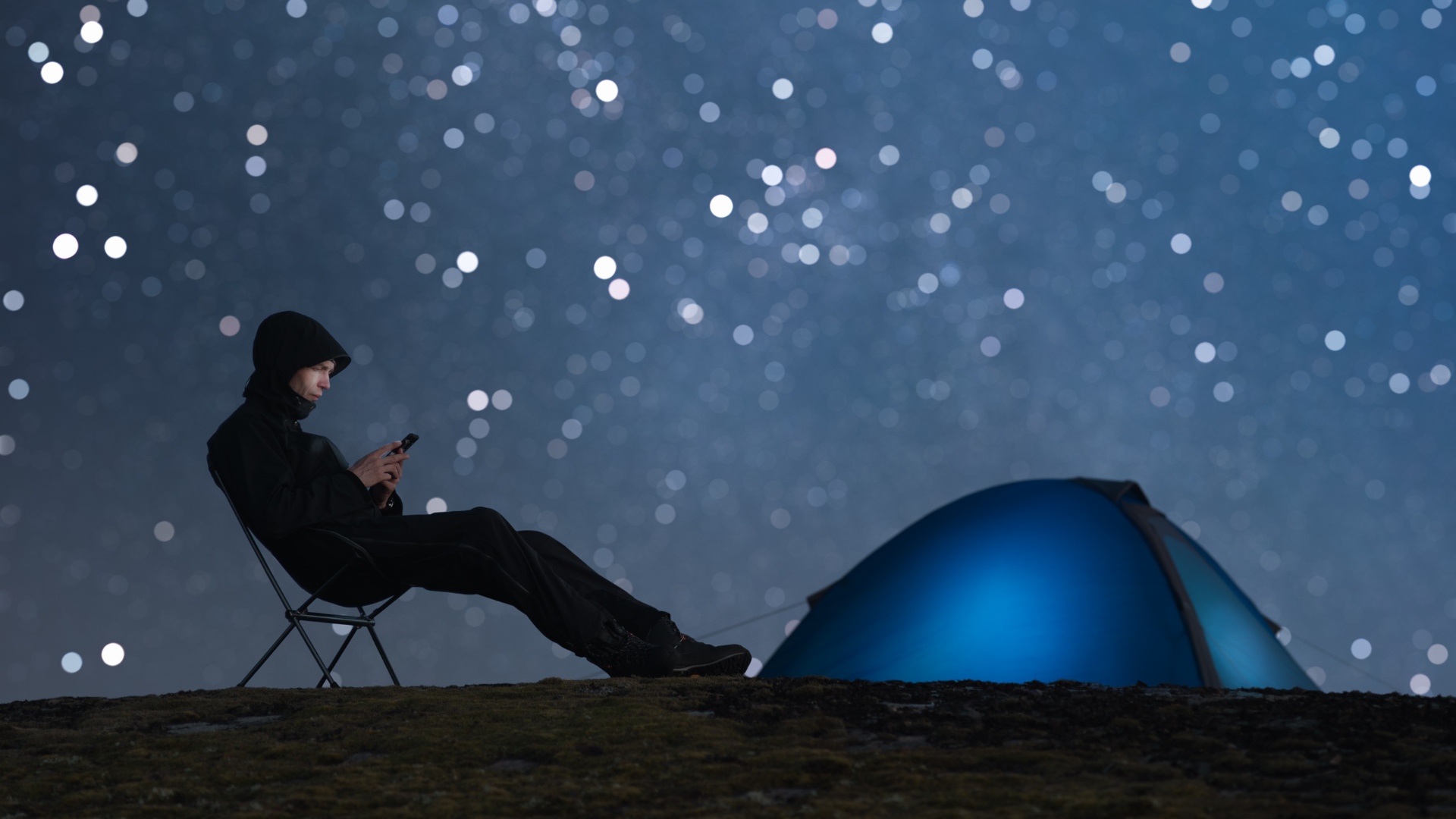
Discover the top 5 astronomy apps that turn your smartphone into a powerful stargazing tool. From real-time sky maps to telescope control...