
9 Night Sky Events to Watch in July 2026 — From a Double Meteor Shower to the Milky Way
Author
Rishabh Nakra
Date Published
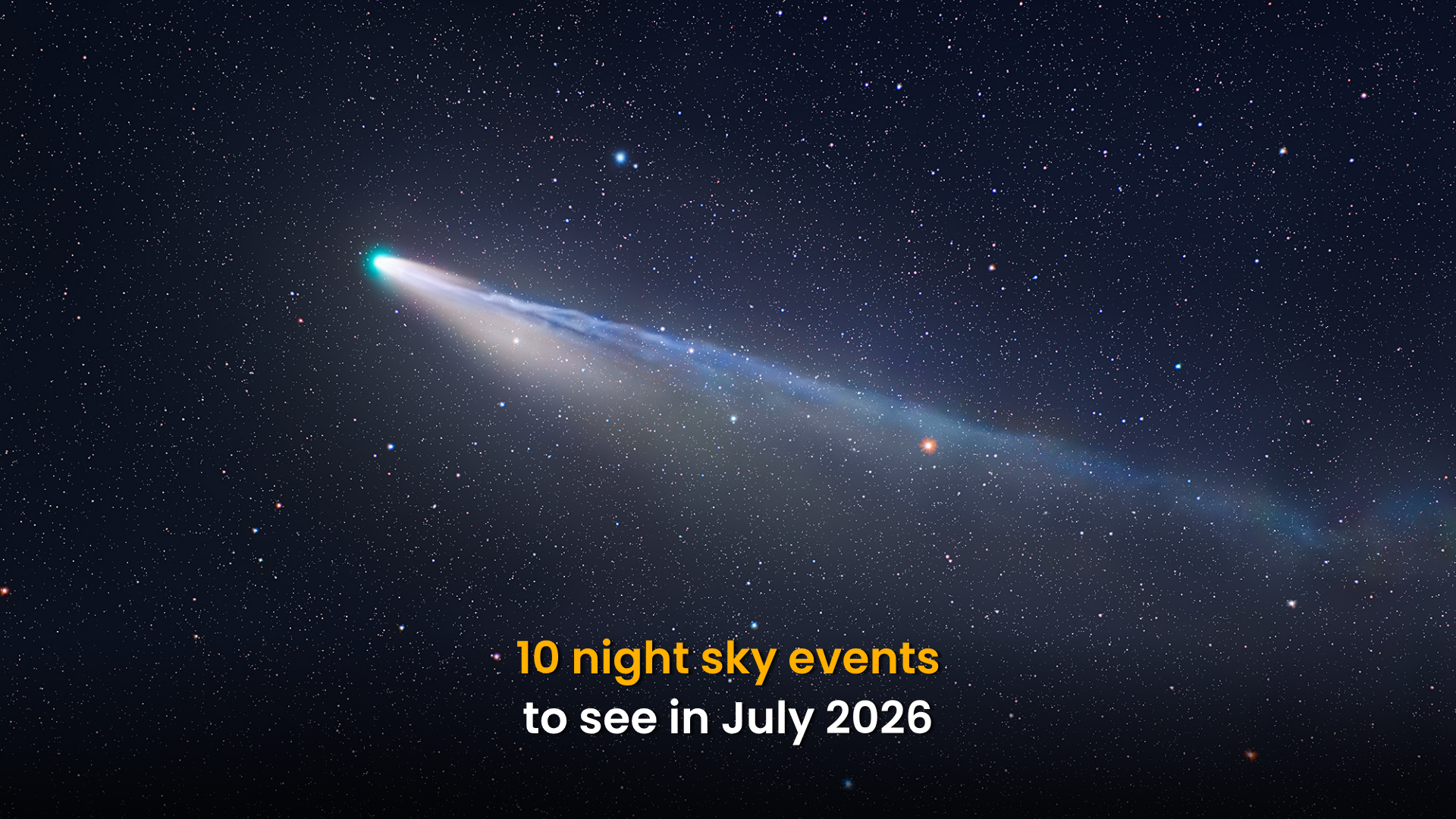
July 2026 is run by the Sun, even after dark.
On the 6th, Earth coasts out to aphelion, the farthest it strays from the Sun all year. Around that point the planets split into two camps. Venus owns the evening west on its own, while a crowded predawn east lines up Mars, Uranus, Saturn, and Neptune before sunrise. Jupiter and Mercury slip behind the Sun entirely.
The faint objects get their turn too. A super new moon on the 14th delivers the darkest skies of the month, and two weeks later Pluto reaches opposition. Then a double meteor shower at the end of July runs straight into a nearly full Moon.
Before we begin, make sure to download one of these space apps to locate the stars and planets according to your place.
July 4 — Mars and Uranus nearly touch before dawn
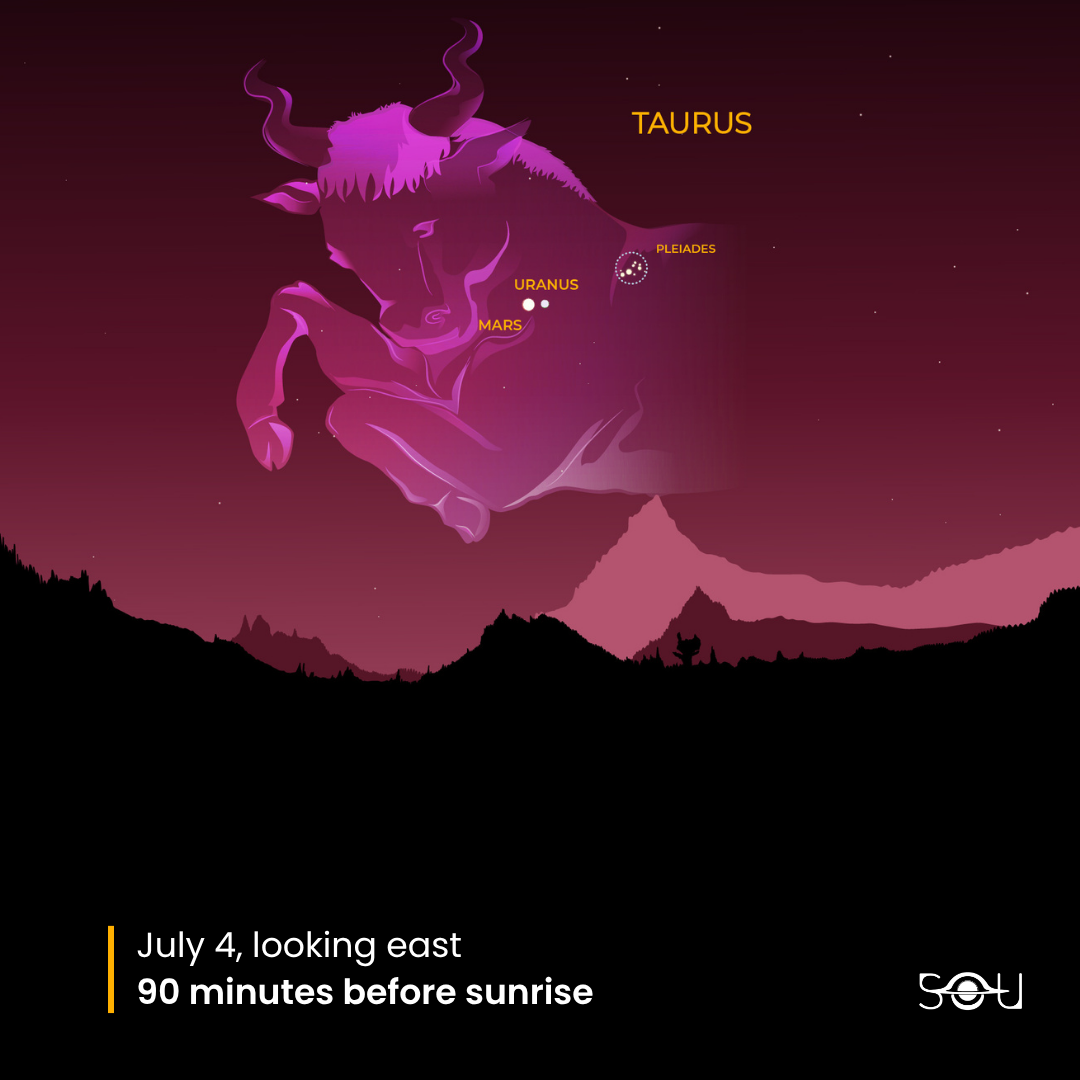
The month opens with a close encounter most people will never see. Low in the east before sunrise, among the stars of Taurus, Mars slides to within about a tenth of a degree of Uranus, the two almost merging into a single point.
Mars, a steady orange dot at magnitude +1.3, is just visible to the naked eye in the brightening twilight; Uranus, far fainter, needs binoculars or a small telescope. The reward for getting up is that Mars hands you Uranus, a planet most people never knowingly find, sitting right beside it.
You will want a flat eastern horizon and clear air, because both sit low and the dawn comes up fast.
July 7 and 8 — The last quarter Moon rides with Saturn
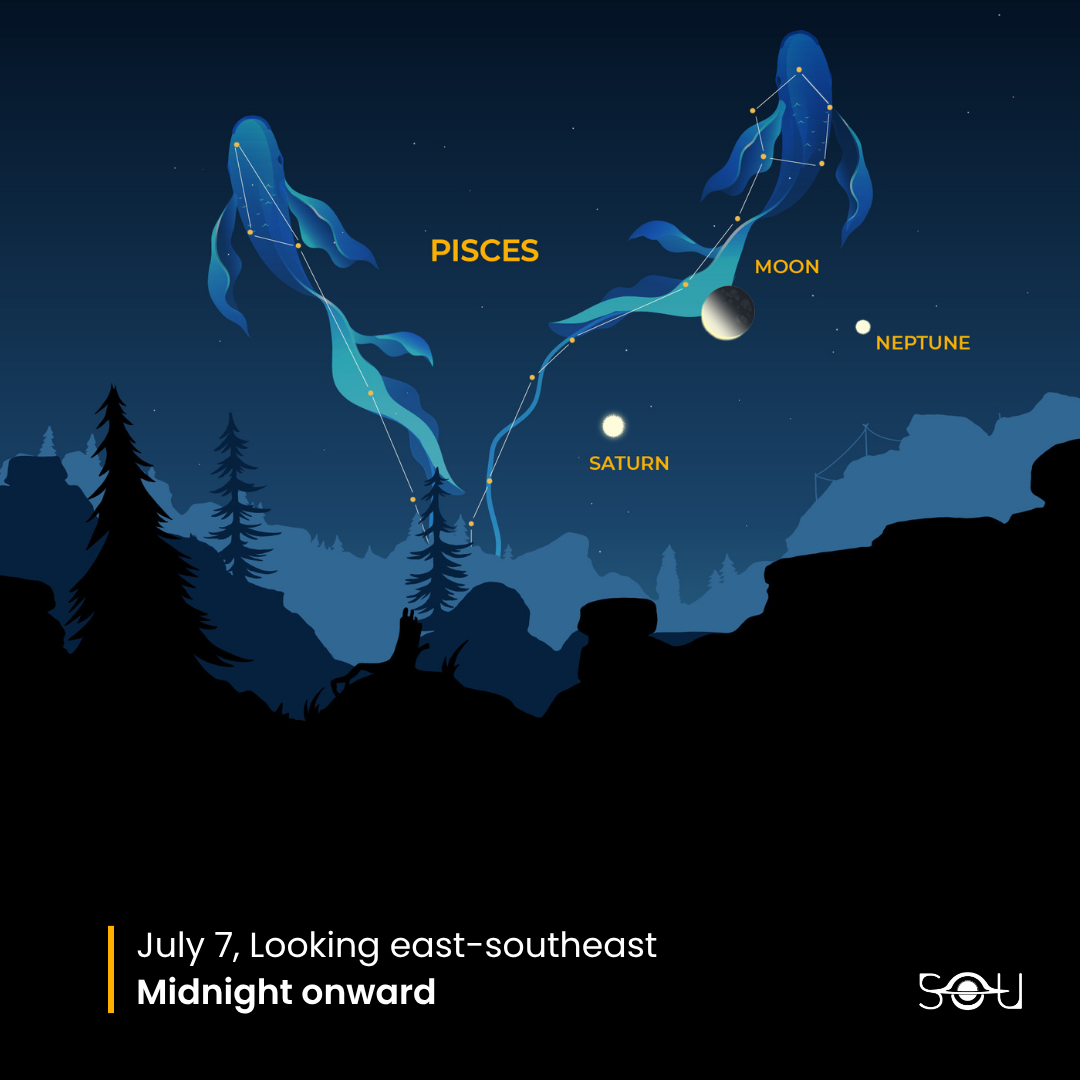
After midnight on July 7 and 8, the last quarter Moon and Saturn climb the eastern sky together, never more than about nine degrees apart, roughly one fist held at arm's length. They travel in tandem until dawn.
Saturn is the planet of the season now, rising late in the evening and standing well up in the south by first light, with its rings tilted nicely for any small telescope. As the morning brightens, faint Mars and the Pleiades star cluster join the scene lower down, a quiet four-way gathering for early risers.
Saturn is still months from its autumn opposition, but it is already worth the alarm.
July 9 — Venus passes Regulus
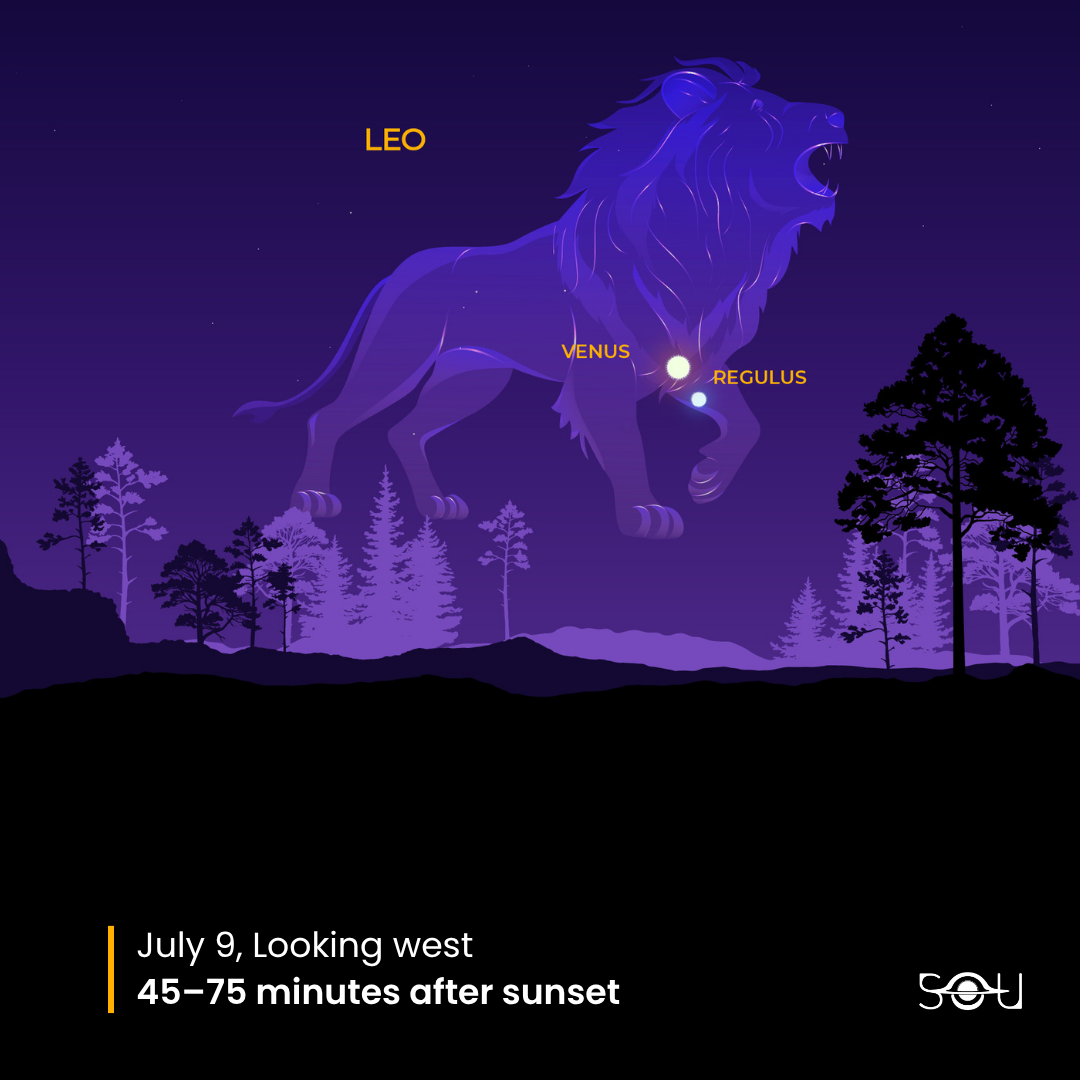
Venus glides past Regulus on July 9, 2026
Turn to the western evening sky for the prettiest naked-eye pairing of the month. Shortly after sunset on July 9, brilliant Venus, blazing at magnitude -4.1, slides about a degree from Regulus, the blue-white heart of Leo the Lion.
Regulus, at magnitude 1.4, is well over a hundred times fainter than Venus, so the contrast is striking: a dazzling beacon and a sharp blue spark side by side, low over the sunset point.
Catch them in the hour after sunset, before they follow the Sun below the horizon. Binoculars frame the pair beautifully.
July 11 — A crescent Moon, the Pleiades, and Mars
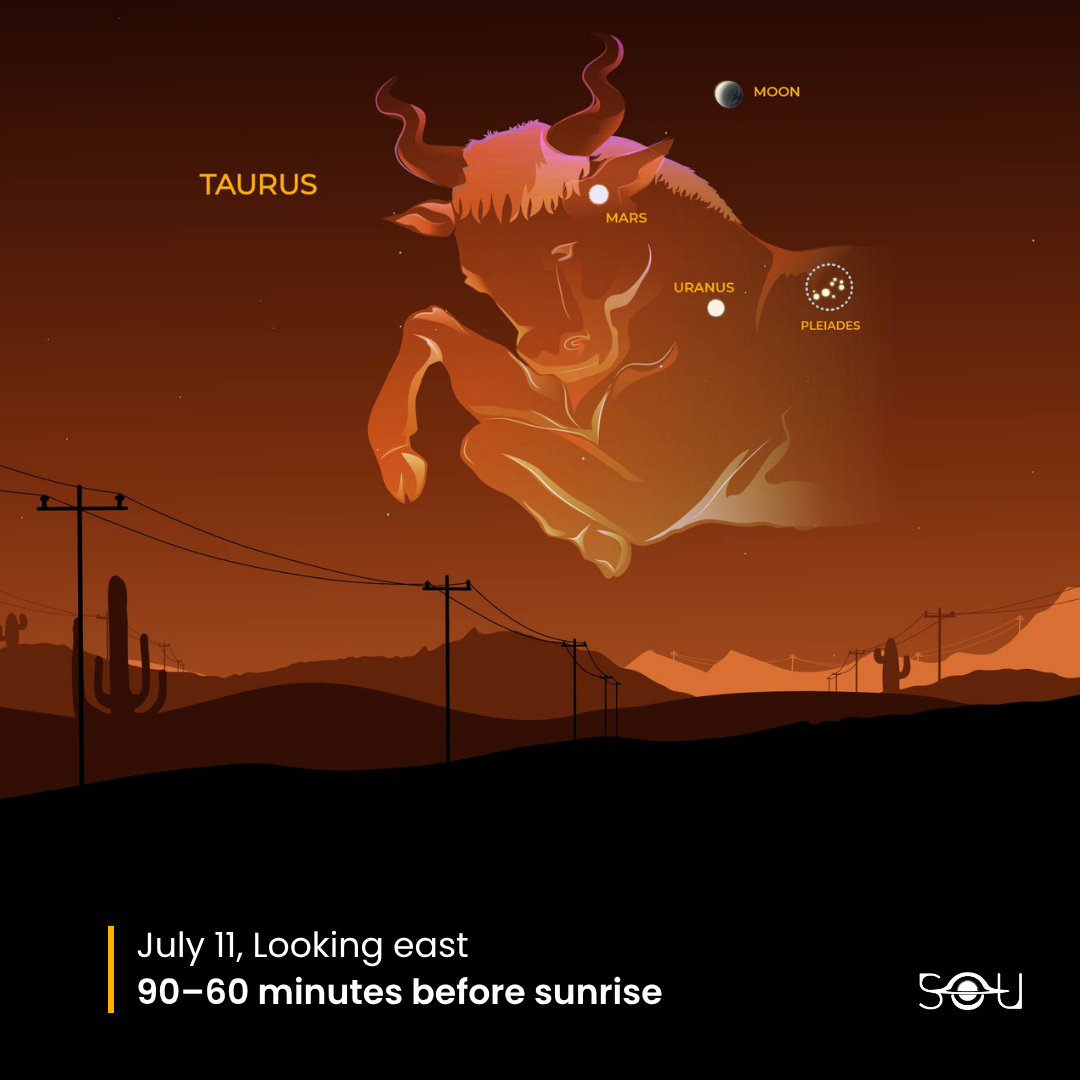
Two mornings later the waning crescent has slipped down to the Pleiades. About two hours before sunrise on July 11, the thin Moon, the tiny dipper-shaped knot of the Pleiades, and orange Mars form a tight triangle low in the east, the three crowded into little more than five degrees, about three finger widths.
The Pleiades repay binoculars: the eye catches six or seven stars, but optics pull dozens more out of the same scrap of sky. It is also a fine morning to trace the craters along the crescent's edge before the Sun rises and the show closes.
July 14 — New Moon, the Milky Way, and a brightening comet
With the Moon new on July 14, the sky goes properly dark, and July's headline target steps forward: the core of the Milky Way.
Look south after full dark and the galaxy's central bulge, a haze of a hundred billion stars toward the constellation Sagittarius, stands high and bright from any site away from city light. This is the best stretch of the year to see it, and to hunt the deep-sky showpieces around it, among them the Lagoon Nebula, the Great Hercules Cluster, and the Ring Nebula.
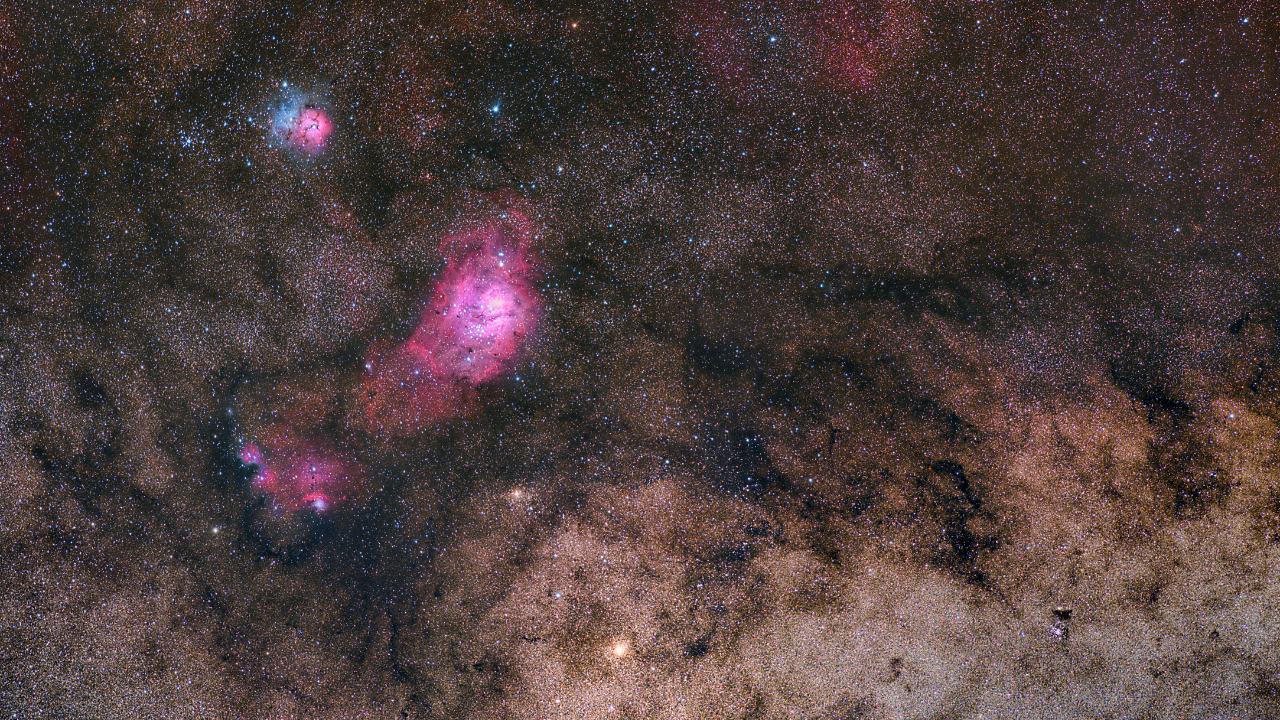
Starfield around the Sagittarius constellation showing three bright nebula: Lagoon Nebula (M8), Trifid Nebula (M20) and NGC 6559. The Lagoon nebula is at centre, the Trifid nebula at upper left, and NGC 6559 at centre left. The red regions are emission nebulae, or clouds of gas ionised by the radiation from hot young stars within them, causing them to glow.
Drifting through the same region is Comet 10P/Tempel 2, a small Jupiter-family comet that rounds the Sun every five years and is brightening toward perihelion in early August. For now it is a small-telescope object near Capricornus and Aquarius; by late July, as it climbs toward roughly eighth magnitude, binoculars should begin to show it.
July 15 to 17 — A new crescent climbs toward Venus
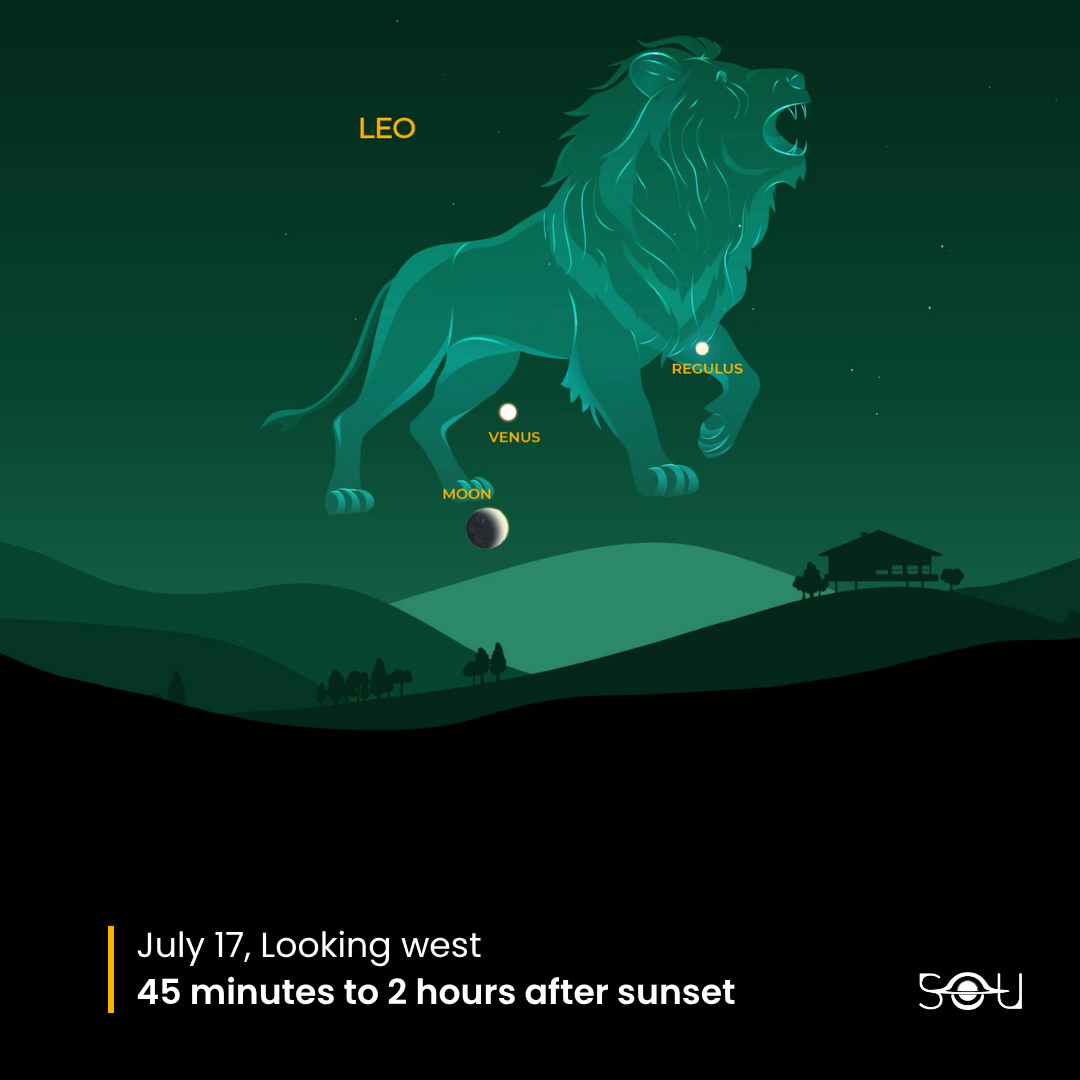
As the Moon returns to the evening sky it makes straight for Venus. On July 15 a slender waxing crescent hangs below Venus and Regulus in the western twilight; by July 17 it has climbed to sit right beside the planet, a classic crescent and evening star pairing low in the west after sunset.
Earthshine, the faint glow of sunlight bounced off Earth onto the Moon's dark side, should fill in the unlit part of the disk. As always with the low western sky, wait until the Sun is fully down before you look.
July 23 and 24 — The gibbous Moon visits Antares
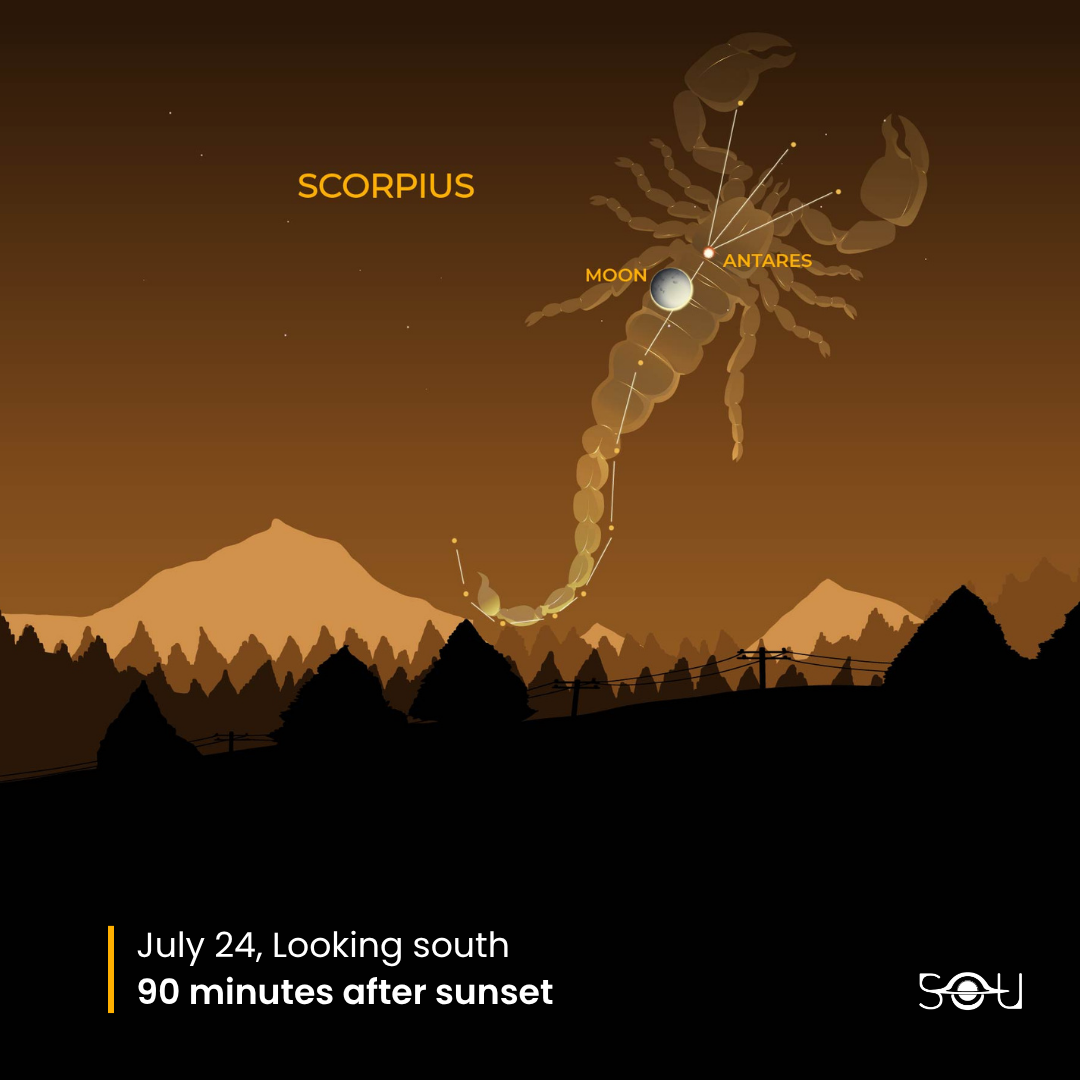
Looking south (overhead Southern Hemisphere)
After sunset on July 23 and 24, the waxing gibbous Moon glides past Antares, the red supergiant that marks the heart of Scorpius, low in the southern sky.
Antares is a star so vast that, set in the Sun's place, it would swallow the orbit of Mars; its name means rival of Mars, for the matching ruddy color that has fooled skywatchers for millennia. The Moon makes an easy pointer to it on these two evenings.
July 28 and 29 — The Buck Moon, and Jupiter vanishes
July's full Moon, the Buck Moon, reaches its peak at 10:36 a.m. EDT on July 29, named for the season when male deer push out their new antlers in velvet. Because the exact moment falls in daylight for the Americas, watch it instead rise full and golden in the southeast on the evenings of July 28 and 29, low among the stars of Capricornus, where the Moon illusion makes it loom large on the horizon.
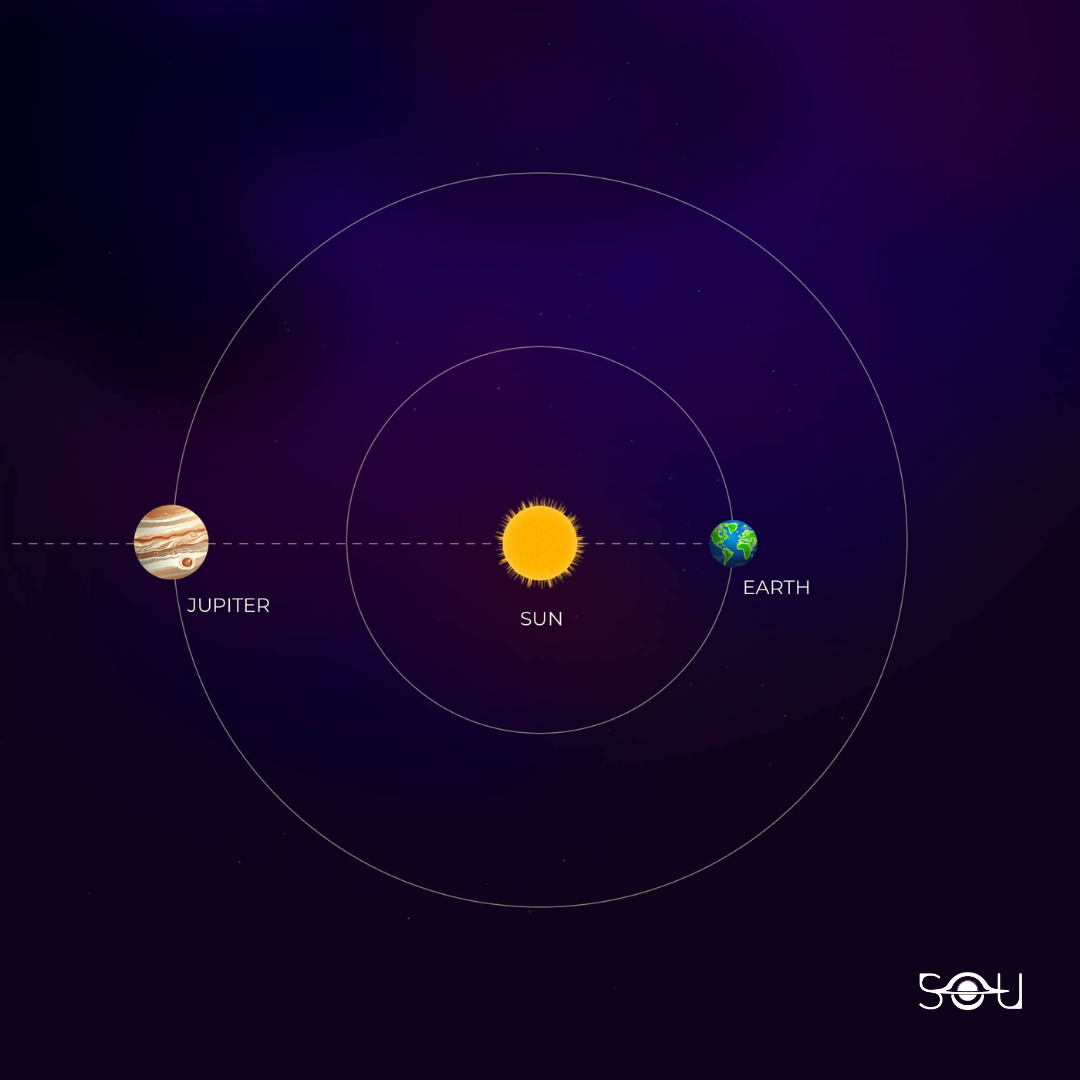
Jupiter at solar conjunction
The same day, Jupiter reaches solar conjunction, passing almost directly behind the Sun and dropping out of the sky entirely; the giant planet will not return until it climbs into the morning twilight in August.
July 30 and 31 — Two meteor showers peak into a bright Moon
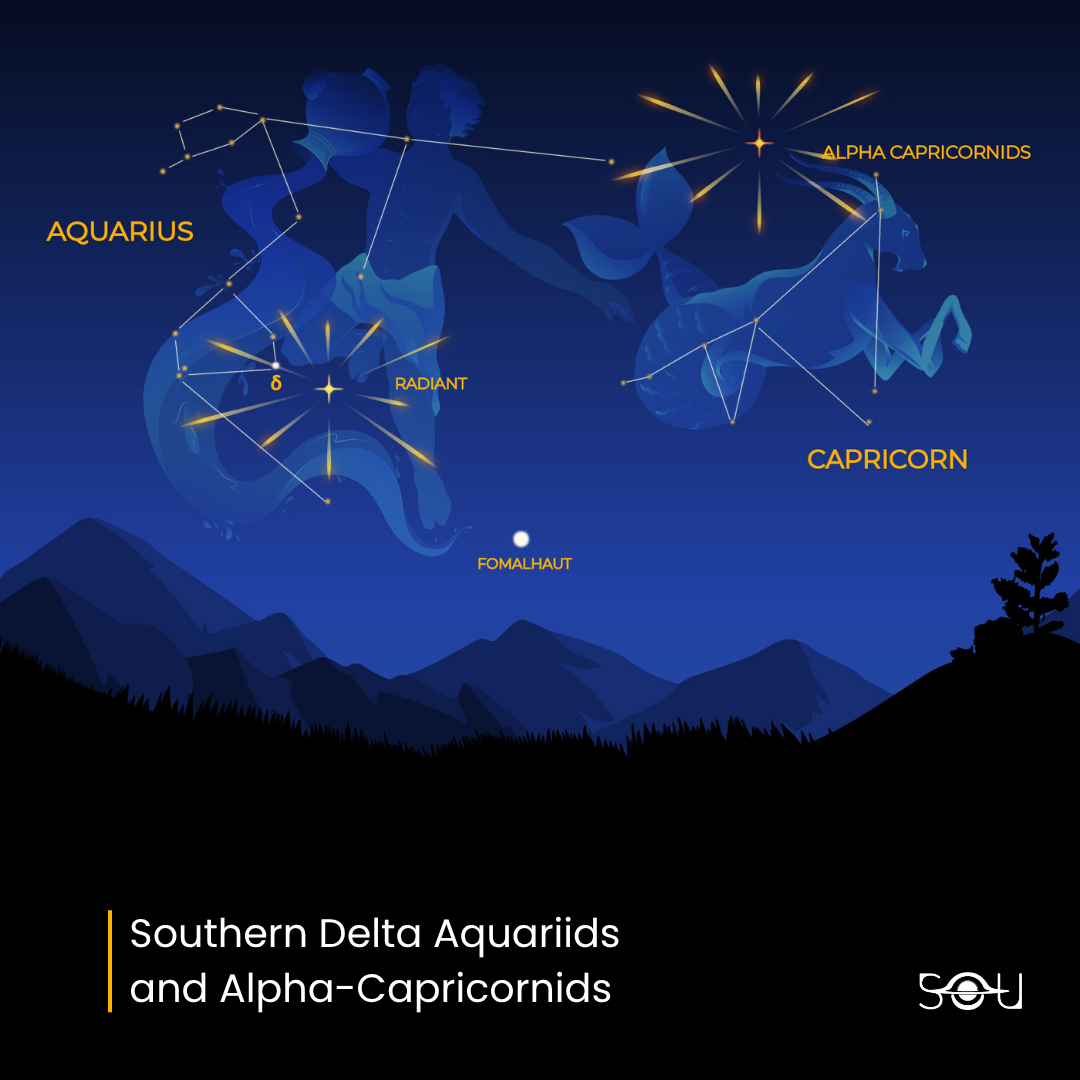
The Southern Delta Aquariid + Alpha Capricornids: Looking south-southeast (radiants in Aquarius/Capricornus), after midnight to dawn
The month closes with two showers reaching their peak together on the nights of July 30 and 31: the Southern Delta Aquariids, with up to around 25 meteors an hour from a radiant in Aquarius, and the Alpha Capricornids, far sparser but known for slow, bright fireballs. Both favor the Southern Hemisphere and the tropics, where the radiants ride higher.
The trouble this year is timing. The Buck Moon was full on July 29, so a nearly full Moon floods the sky through both peaks and drowns all but the brightest meteors. If you go out, look well away from the Moon in the hours after midnight, and treat any Capricornid fireball as a bonus.
The consolation is already building: the Perseids have been active since mid-July and are climbing slowly toward a peak on August 12 and 13 that, this year, falls under a new Moon, with none of this month's glare to spoil it.
July 2026 Lunar Calendar
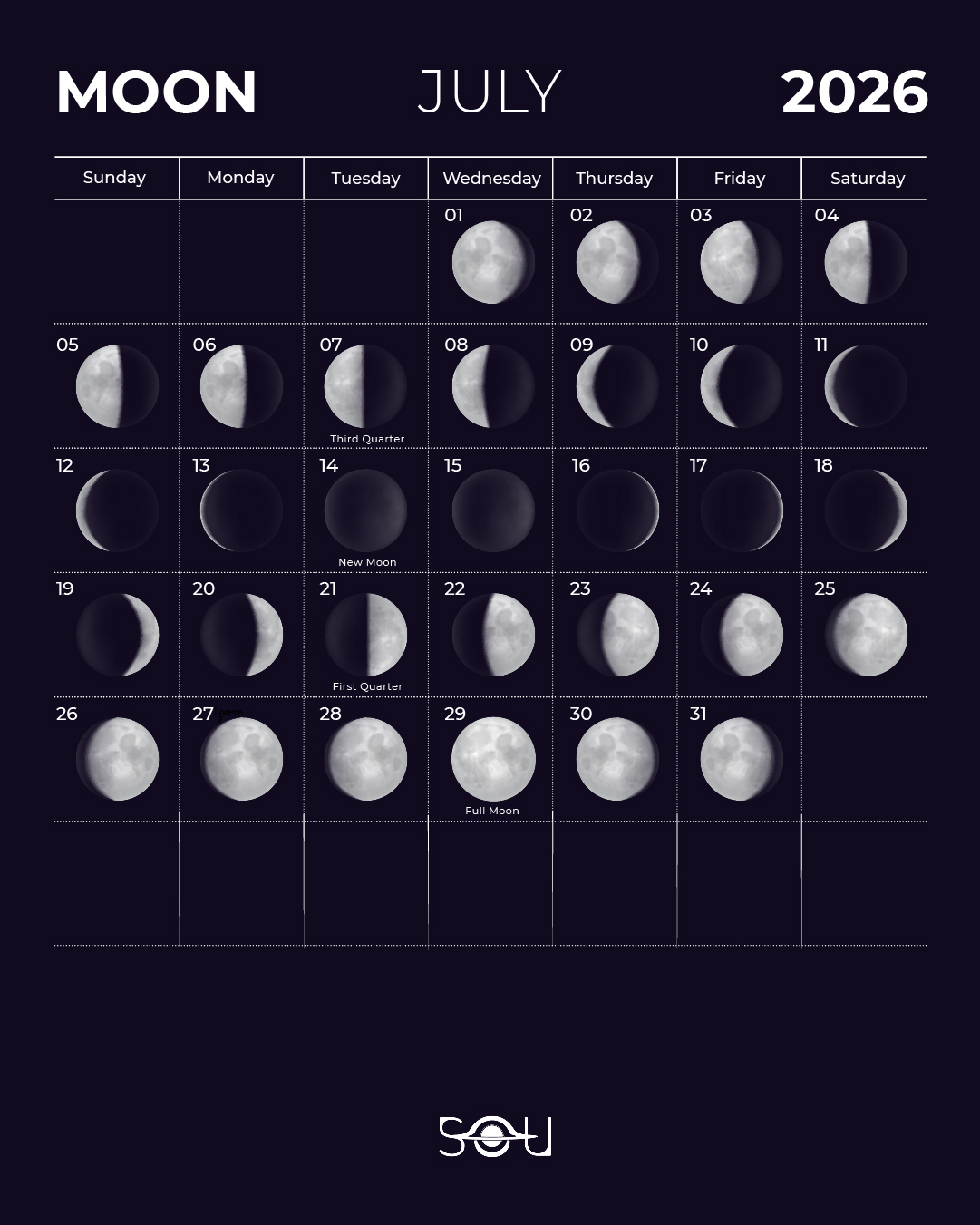
Moon Calendar July 2026
July 2026 Planet Round-up
Mercury starts July lost in the Sun's glare, reaching inferior conjunction on July 13 as it passes between Earth and the Sun, then climbs into the dawn at the very end of the month, rising about an hour and a half before sunrise by July 31.
Venus rules the western evening sky as the brilliant evening star at magnitude -4.1, passing Regulus on July 9 and edging a little farther from the Sun each week toward its greatest distance in mid-August.
Mars is faint and low in the predawn east at magnitude +1.3, skimming past Uranus on July 4 and the bright star Aldebaran around July 13 as it works its way through Taurus.
Jupiter spends July sinking into the sunset and reaches solar conjunction on July 29, hidden behind the Sun and absent from the sky until it returns to the morning twilight in August.
Saturn is the planet of the night, rising in the late evening and standing high in the south by dawn among the stars of Pisces, its rings well placed for a small telescope. It begins retrograde motion around July 25, appearing to drift slowly backward against the stars, an optical effect of faster Earth overtaking the more distant planet as both move toward Saturn's October 4 opposition, when the ringed planet will be closest, brightest, and visible all night.
Uranus is a faint morning object in Taurus, easiest to locate on July 4 when Mars sits right beside it, though it still needs binoculars or a telescope.
Neptune is a telescope-only target in the predawn sky, drifting near Saturn at around eighth magnitude and far too faint for the naked eye.

Discover the top 5 astronomy apps that turn your smartphone into a powerful stargazing tool. From real-time sky maps to telescope control...