
Perseid Meteor Shower 2026: How to Watch the Best Peak in Years
Author
Rishabh Nakra
Date Published
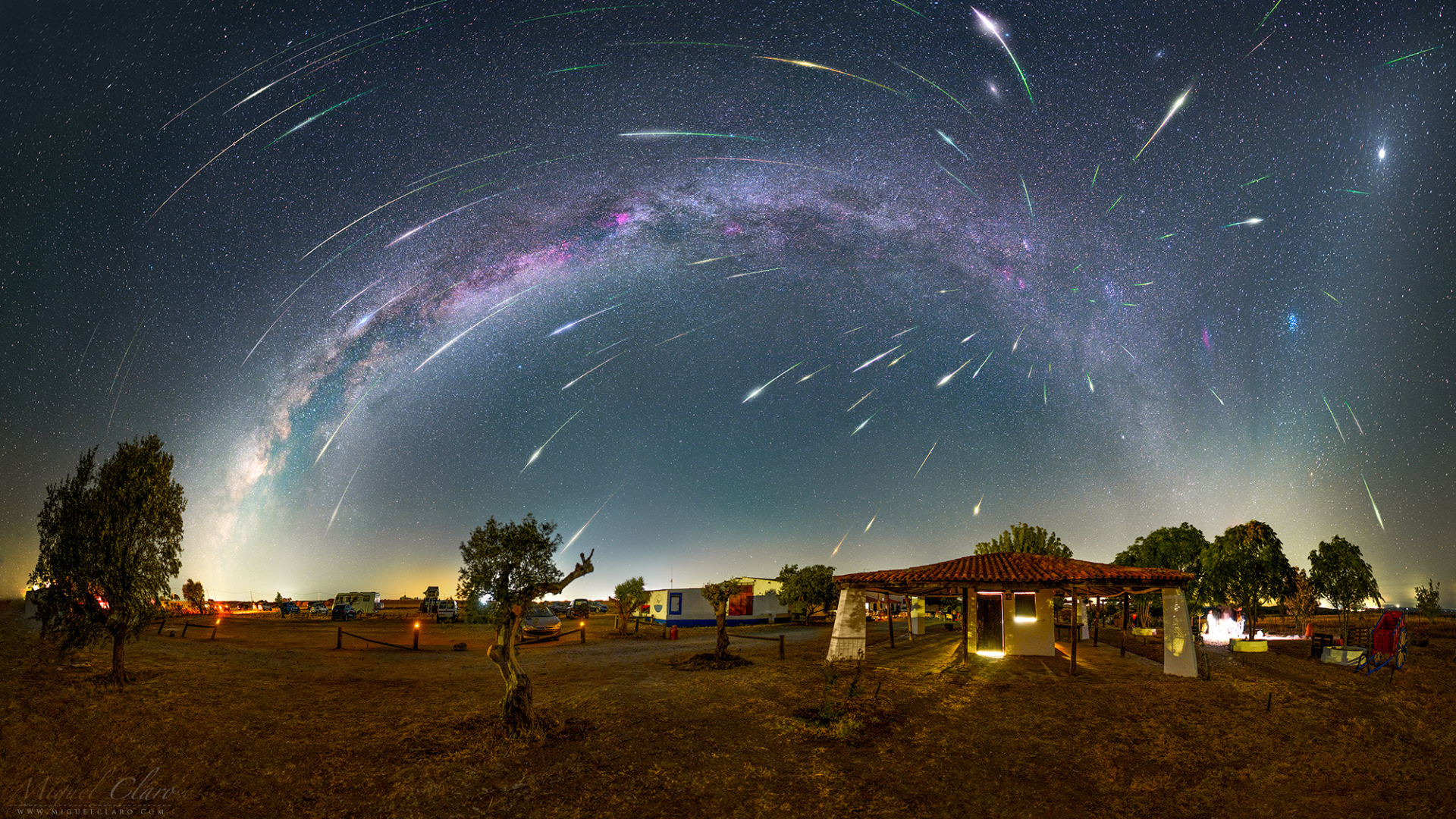
On August 12, 2026, the Moon has two jobs. In the afternoon it slides across the face of the Sun and turns day into night along a narrow track through Iceland and Spain. Then it disappears completely, leaving the rest of the planet under the darkest sky of the year.
That second act is the one almost everyone can see. The Perseid meteor shower, the most watched shower on Earth, reaches its peak that very night, and for the first time in years there will be no moonlight to wash it out.
The last time the calendar stacked a total solar eclipse, a moonless Perseid peak, a prime Milky Way night and a six-planet lineup into a single 24-hour stretch, nobody reading this was checking a weather app. The question is not whether to go out. It is how to use every hour.
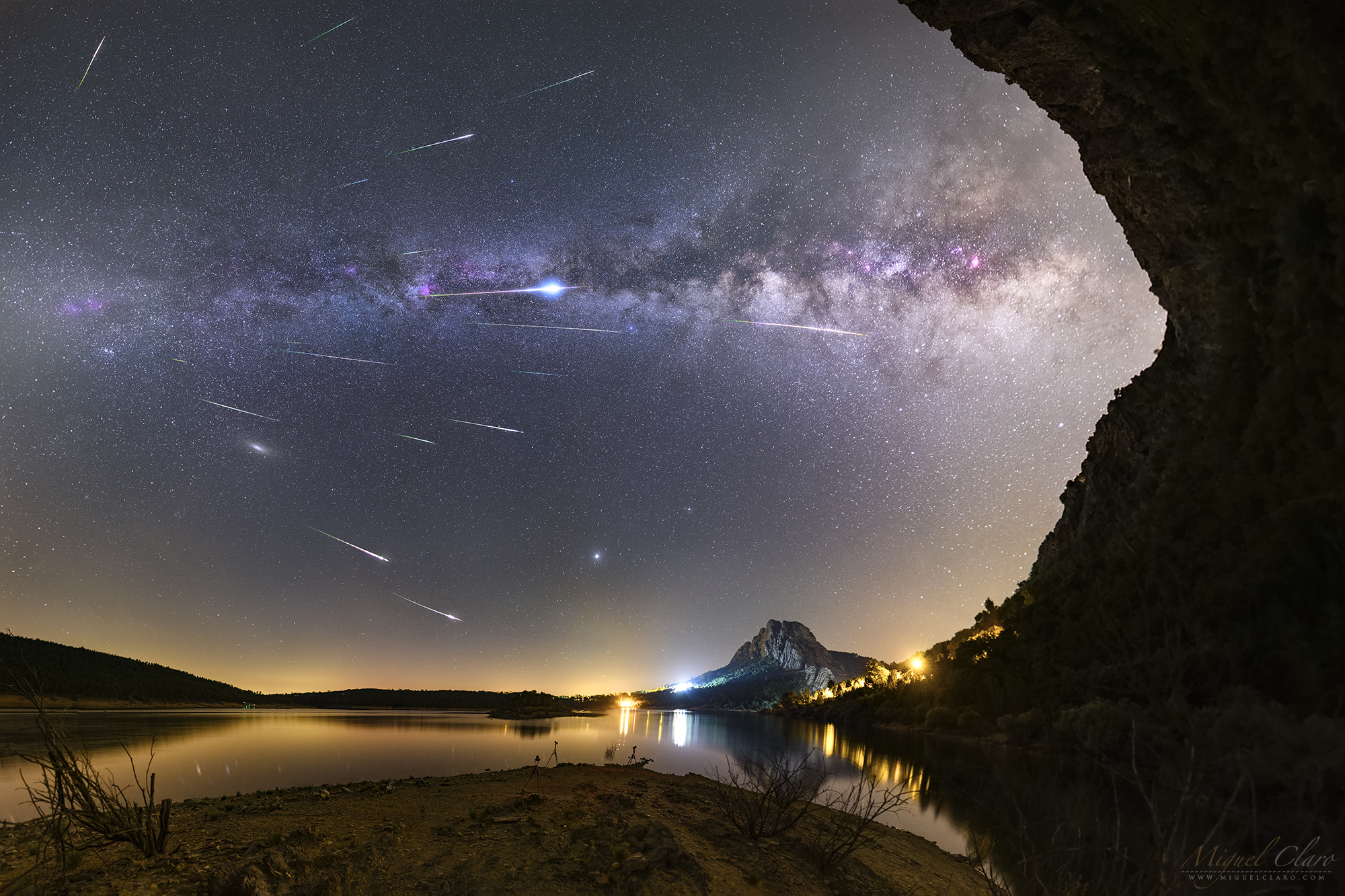
Arch of the summer Milky Way shines during the Perseid meteor shower
Why This Peak Is Different
Every August, Earth ploughs through the debris left by comet 109P/Swift-Tuttle, a 26-kilometre (16-mile) body on a 133-year orbit, last seen in 1992 and not due back until 2126. Sand-grain fragments slam into the atmosphere at 59 kilometres (37 miles) per second and burn up about 100 kilometres (60 miles) overhead as Perseid meteors.
The shower runs from July 17 to August 24, but the night that matters is August 12 to 13. The American Meteor Society places the peak at 14:53 UTC on August 13 (10:53 a.m. Eastern), which favours Asia and the Pacific, yet the Perseid maximum is broad. Strong rates flow through the whole night on both sides of that moment.
The International Meteor Organization adds a wrinkle: a filament of older comet debris may cross Earth's path around 01:00 UTC on August 13 (9:00 p.m. Eastern, August 12), give or take five hours, potentially boosting counts early in the night for Europe and North America.
What makes 2026 exceptional is the Moon, which is new at 17:37 UTC on August 12 (1:37 p.m. Eastern). Zero moonlight, all night, on peak night. Under those conditions a dark rural sky can serve up 50 to 75 meteors an hour, with bursts approaching the shower's catalogued rate of 100.
Treat that 100 with care. It is a zenithal hourly rate, an idealised figure assuming a perfect sky and the radiant directly overhead, which never quite happens. Real counts run lower, but 2026 closes the gap about as far as nature allows: the shower's faint majority, normally erased by moonlight, will be visible.
How to Watch, Hour by Hour
No telescope, no binoculars. Your eyes take in the whole sky at once, and that is exactly what a meteor shower needs. Find the darkest site you can reach, face roughly northeast, lie back, and give your eyes a full 30 minutes to adapt. Every glance at a phone screen resets the clock.
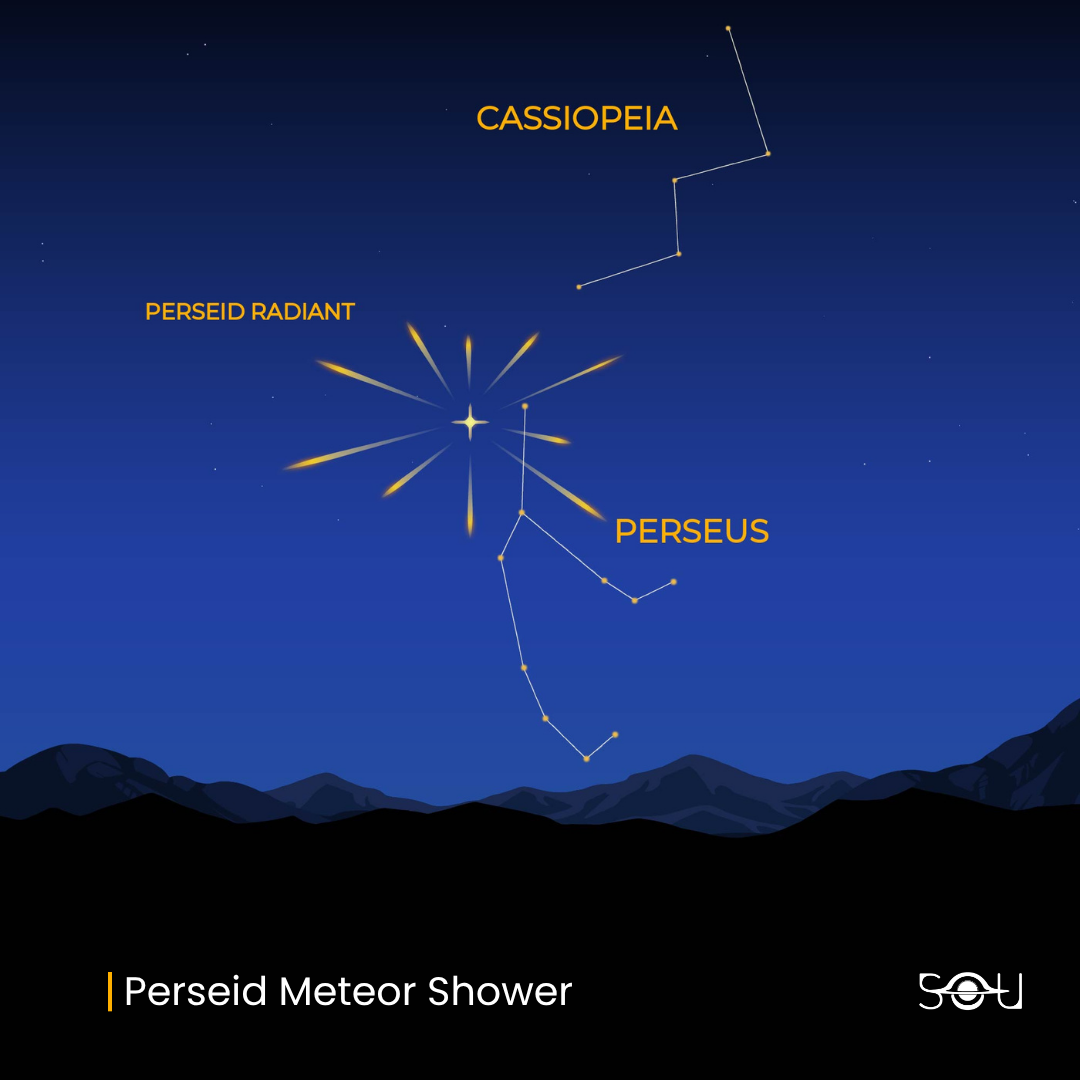
Radiant of the Perseid meteor shower
The radiant, the point the meteors appear to stream from, sits in Perseus near the famous Double Cluster. It clears the horizon by mid-evening and climbs all night, so rates climb with it. But do not stare at Perseus itself. Meteors streak across every part of the sky; the radiant only tells you which direction their trails point back to.
Comfort decides how long you last. Bring a reclining chair or a blanket, a warm layer even in August, and a red torch that preserves night vision. Check the cloud forecast that afternoon and have a backup site in mind; a 30-minute drive away from city glow can double or triple your meteor count. In most years moonlight steals the faint majority of Perseids. This year, only clouds and streetlights can.
Early evening rewards patience with earthgrazers: rare, slow meteors that skim the atmosphere at a shallow angle and can burn for several seconds across half the sky. The serious numbers arrive later. For eastern North America, the prime window runs from about 04:00 to 09:30 UTC on August 13 (midnight to 5:30 a.m. Eastern), with the single best hour around 07:00 to 08:00 UTC (3:00 to 4:00 a.m. Eastern), when Perseus stands high and dawn has not yet begun.
The Best Milky Way Night of the Year
A moonless mid-August night is the sweet spot for the Milky Way, and this one lands exactly on the Perseid peak. Once evening twilight fades on August 12, the galaxy's bright core hangs in the south for mid-northern observers, glowing toward Sagittarius before it sinks in the small hours.
From there the band arcs overhead through the Summer Triangle, where the Great Rift, a lane of interstellar dust, splits it in two. This is the richest stretch of sky visible from the Northern Hemisphere, and on this night nothing dims it.
The practical upshot: while you wait for meteors, you are lying under the best naked-eye view of our own galaxy that 2026 will offer. Photographers get a rare twofer, Perseids and the galactic core in the same frame, with no lunar glow to fight.
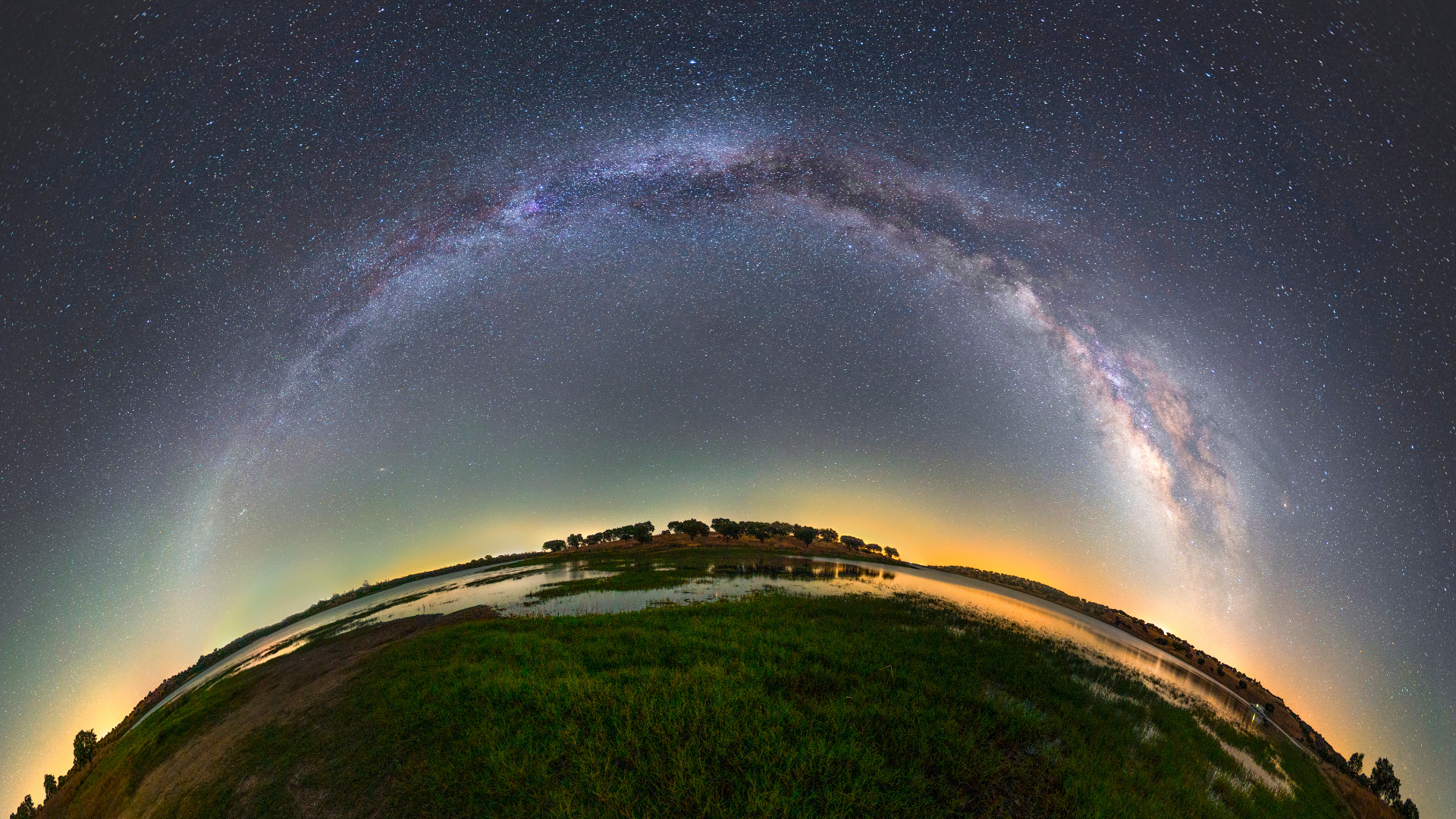
Arc of the Milky Way over the Alqueva lake in the Dark Sky Alqueva preserve, Portugal. Dozens of emission nebulae and dark dust lanes spread along the Milky Way path. The presence of the Andromeda Galaxy is seen as a small, oblong, diffuse shape. The greenish smooth light surrounding the horizon is due to the presence of airglow (photochemical luminescence of the atmosphere).
Stay Up for the Planet Parade
Do not pack up when the meteors thin toward dawn. In the last dark hour of August 13, six planets share the sky: Saturn, Neptune, Uranus, Mars, Mercury and Jupiter, strung from high in the south down to the brightening east.
Saturn rides highest and is unmistakable to the naked eye, with Neptune lurking nearby for telescope users. Uranus sits near the Pleiades, a binocular target. The tricky trio hugs the eastern horizon: Mars and Mercury low in the gathering twilight, and Jupiter lowest of all, rising just ahead of the Sun.
One name is missing. Venus sits this one out, hidden in the Sun's glare around inferior conjunction in mid-August; it re-emerges as a brilliant morning star in the autumn. Its absence is the only asterisk on an otherwise crowded sky.
For eastern North America, try roughly 08:45 to 09:45 UTC (4:45 to 5:45 a.m. Eastern) with a flat, unobstructed eastern horizon. You will not need all six to make the morning; four naked-eye planets after a night of meteors is its own reward.
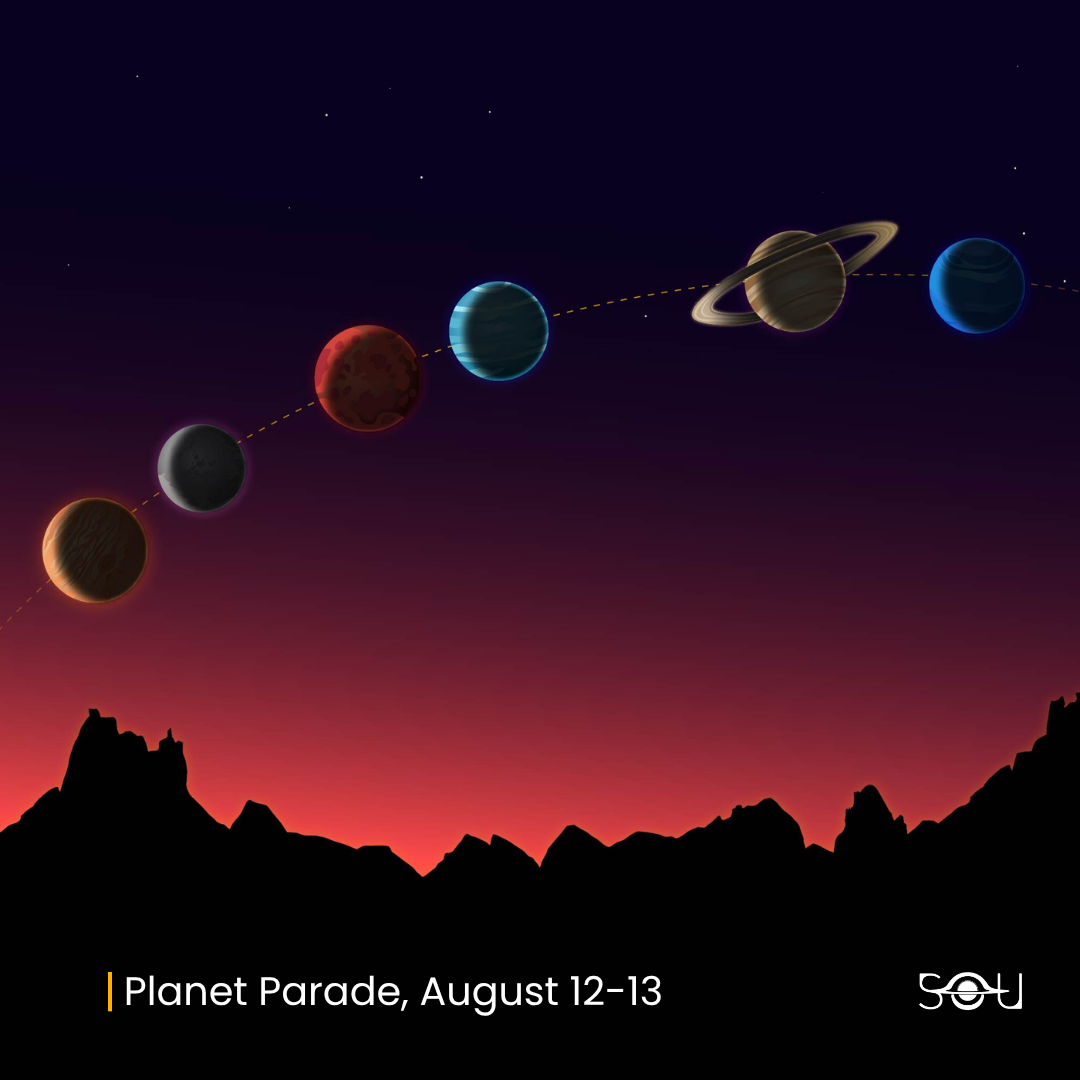
Planet Parade August 12-13, 2026
The Eclipse That Sets It All Up
The reason the night is so dark is the same reason the day is extraordinary. A total solar eclipse can only happen at new moon, and this new moon delivers the first totality over mainland Europe since August 1999.
The partial phases begin at 15:34 UTC (11:34 a.m. Eastern). The Moon's shadow crosses Arctic Russia and Greenland, sweeps western Iceland from 17:43 to 17:50 UTC (1:43 to 1:50 p.m. Eastern), including Reykjavik, then leaps the Atlantic to reach northern Spain at 18:26 UTC (2:26 p.m. Eastern) for a dramatic low-Sun totality lasting up to 2 minutes 18 seconds. A partial eclipse reaches much of Europe, Canada and parts of the northern United States before ending at 19:57 UTC (3:57 p.m. Eastern).
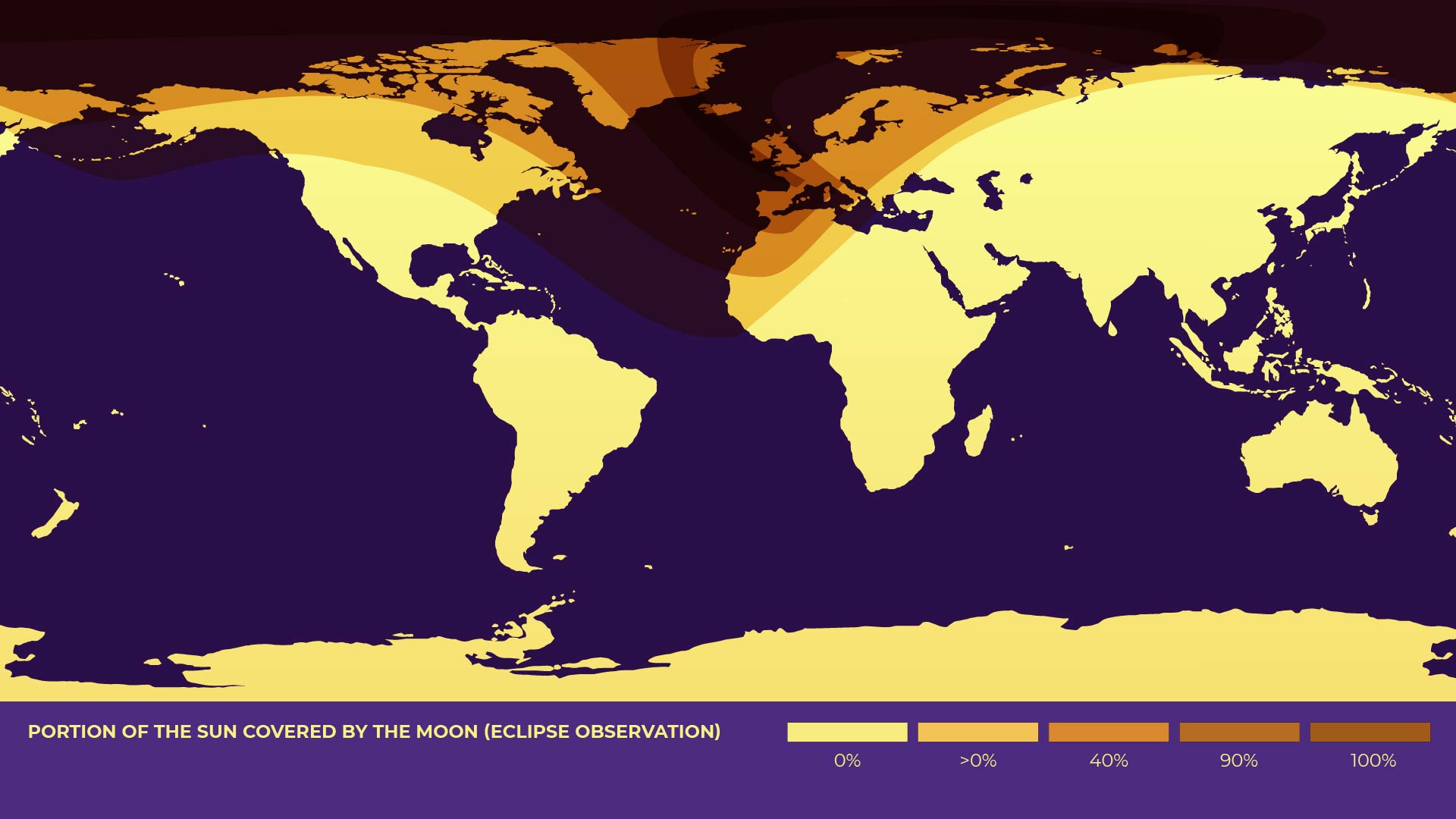
Map of the August 12, 2026 solar eclipse
Anyone standing in that shadow gets the full sequence: totality in the evening, Perseids and the Milky Way through the night, planets at dawn. The rest of us get three out of four. Swift-Tuttle itself will not swing past Earth again until 2126, but the debris it has already shed keeps this appointment every August. It is the Moon that rarely cooperates this completely. On August 12, 2026, it does.
The bright core of the Milky Way is only in season for a few months. Here is when to see it, and why June to August belong to the whole planet.
Discover the top 5 astronomy apps that turn your smartphone into a powerful stargazing tool. From real-time sky maps to telescope control...