
Voyager 1 Could Have Reached Pluto in 1986. Here Is What It Chose Instead.
Author
Shreejaya Karantha
Date Published
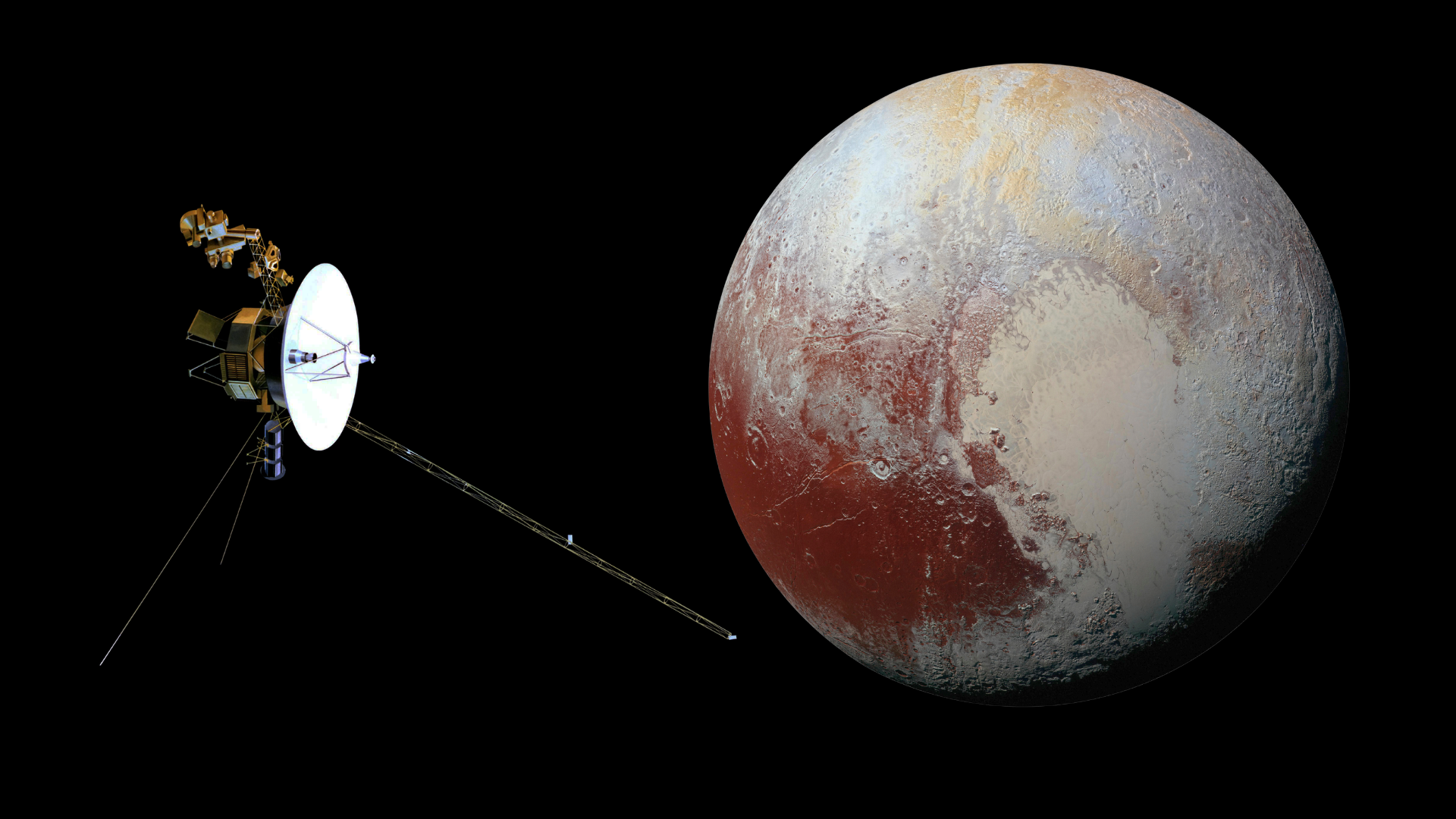
In November 1980, a spacecraft passed Saturn and made a choice that could never be undone. It could study a hazy, unexplored moon, or it could continue on toward Pluto, the last unvisited planet in the solar system. It couldn't do both. Voyager 1 chose the moon. Pluto waited another 29 years for a visitor.
The Fork That Was Built Into the Mission
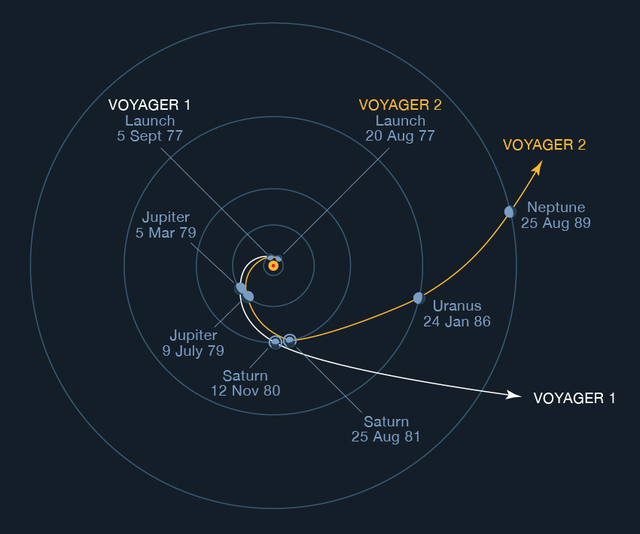
An illustration of the trajectories of Voyager 1 and Voyager 2.
That decision wasn't made in real time. It was built into the mission years before launch. Voyager 1 and Voyager 2 left Earth in 1977 to survey Jupiter and Saturn. The mission was part of a scaled-down version of an original "grand tour" concept that budget cuts had trimmed in the early 1970s. By the time of launch, scientific interest in Saturn's moon Titan had grown enough to reshape Voyager 1's entire flight plan. Titan was the only moon in the solar system known to have a thick atmosphere. The mission planners built the spacecraft’s trajectory to take a close look at this rare enough feature.
However, flying close enough to study Titan meant passing beneath Saturn's south pole and out of the ecliptic — the flat plane in which the planets orbit the Sun. So, once Voyager 1 left that plane, a visit to Uranus, Neptune, or Pluto became impossible.
Six Years to Pluto, or None
NASA has been direct about the trade-off: Voyager 1 could have been aimed at Pluto instead, but Titan and Saturn's rings were considered the higher scientific priority, and that choice sent the spacecraft's trajectory permanently out of reach of the remaining planets. Without the Titan diversion, calculations suggest Voyager 1 could have reached Pluto by 1986, just months after Voyager 2's flyby of Uranus that same January.
There was another catch: Voyager 2's path depended on Voyager 1 succeeding at Titan first. As mentioned in NASA’s official website: “Once Voyager 1 had successfully gathered data at Titan, Voyager 2 was allowed to go on to Uranus and Neptune.” If Voyager 1 had gone to Pluto instead, Voyager 2 would have had to study Titan itself — and that flyby would have ended its journey at Saturn, too, ruling out Uranus and Neptune.
What the Moon Actually Gave Back
Voyager 1 passed within about 4,034 miles (6492 km) of the moon, but its cameras found only an orange haze — a thick, organic smog that blocked visible light entirely, leaving nothing but a faint brightness contrast and a dark polar hood. The unflattering imagery could be mistaken for a canvas painted with blue and orange colors.

Layers of haze covering Saturn's moon Titan are seen in this image taken by Voyager 1 on November 12, 1980.
Nevertheless, the spacecraft's instruments told a richer story. Using radio occultation that tracks how its signal bent as it passed through Titan's atmosphere on the way back to Earth, Voyager 1 measured its surface radius for the first time. The data also revealed an atmosphere of 90% nitrogen with some methane and more complex hydrocarbons. Its surface pressure was found to be nearly 60 percent greater than Earth's, and temperatures around minus 293 degrees Fahrenheit. That mix of nitrogen, methane, and heavier hydrocarbons hinted at the kind of prebiotic chemistry that makes Titan one of the most scientifically interesting worlds in the solar system today.
The Ignorance That Made the Choice Look Different
It's worth knowing what mission planners didn't know in 1980. Pluto had no known context yet. The Kuiper Belt itself was discovered in 1992 so there was no reason to think Pluto belonged to anything larger than itself. To a planner working in 1980, Titan was a large moon with a real atmosphere and possible organic chemistry; Pluto was a small, isolated oddity at the edge of the map. Framed that way, the choice looks almost obvious.
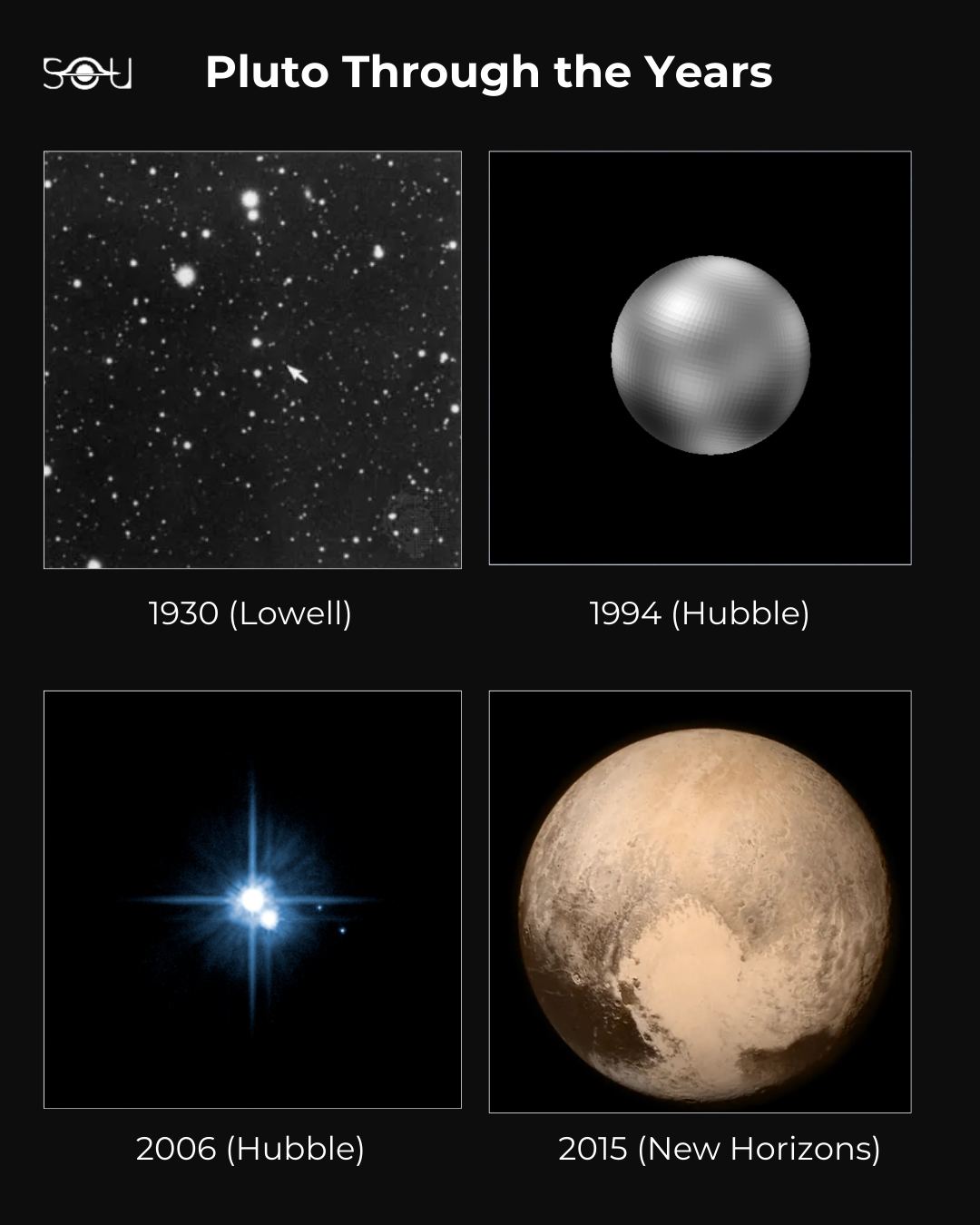
Pluto through the years
The Titan flyby ended Voyager 1's planetary tour and began an entirely different one. The spacecraft is now leaving the solar system at roughly 3.5 astronomical units per year, climbing 35 degrees north of the ecliptic toward the constellation Ophiuchus. On August 25, 2012, it crossed the heliopause and became the first human-made object to reach interstellar space. Decades earlier, on Valentine's Day 1990, it turned its cameras back toward the Sun for the first-ever portrait of the solar system from the outside.
The spacecraft is aging. Each of its radioisotope generators loses about four watts of power a year, and instruments have been shut down one by one to conserve what's left. Both Voyagers were still transmitting as of April 2026, and NASA expects contact may be possible until roughly 2036.
Meanwhile, the mission that finally reached Pluto is still going. New Horizons arrived in July 2015 — 29 years later than Voyager 1 could have gotten there — and NASA confirmed recently that the spacecraft has come out of hibernation in good health, continuing outward through a region of the solar system Voyager's planners never knew existed.
Also Read
How to See the Milky Way's Core, From Anywhere on Earth
Tiny Object Beyond Neptune Found With Mysterious Atmosphere
The Milky Way Has an Edge, And Astronomers May Have Just Found It.

Cassini data reveal complex organic molecules in Enceladus’ plumes, strengthening the case that Saturn’s icy moon may host the precursors of life.

Astronomers have found a thin atmosphere around 2002 XV93, a tiny icy world beyond Neptune that should be too small to hold one.
A strange LIGO signal may reveal primordial black holes—ancient objects that could explain the mysterious dark matter in our Universe.